
Part 2: Energy & Ratepayer Protection
The largest transfer of wealth from your community to a data center developer will never appear in the agreement you sign. It happens silently, every month, on every resident's electric bill — unless you stop it. This chapter is how you stop it.
2.0 Why this is the most important chapter in the handbook
Most of what a community negotiates with a data center — jobs, community funds, noise limits, water caps — is visible, local, and bounded. The energy question is none of those things. It is invisible (buried in utility rate cases most residents never hear about), regional (decided at a state commission, not city hall), and effectively unbounded (a single gigawatt campus can reshape an entire utility's capital plan).
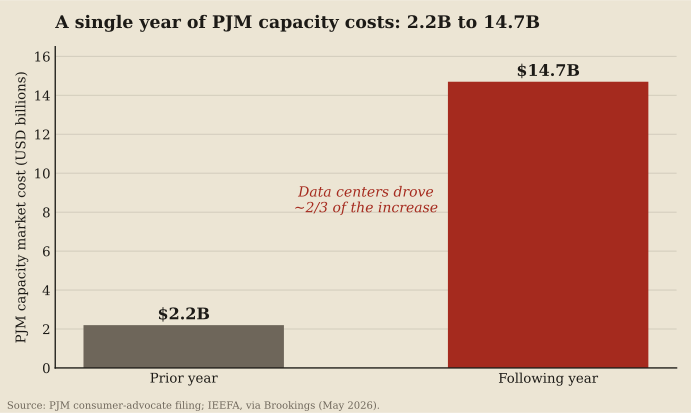
It is also where the money is. When power-supply costs in the 13-state PJM grid region jumped from $2.2 billion to $14.7 billion in a single year — with data centers responsible for nearly two-thirds of the increase — that cost did not land on the data centers. Under traditional ratemaking, it landed on the 65 million people who share that grid.
The good news: this is the most rapidly maturing area of data center policy in the country. As of mid-2026, twenty-three states have approved at least one large-load tariff and seven more have proposals pending (Edison Electric Institute). A clear "large-load rate archetype" has emerged from 77 utility filings tracked in the DELTa database (SEPA / NC Clean Energy Technology Center). Your community does not have to invent these protections — you have to demand they apply to your project, and demand they be strong.
This chapter gives you the mechanism, the precedents with real numbers, and a demand-by-demand checklist with the justification for each.
2.1 How the harm happens: cost causation vs. cost shifting
Regulated utilities recover their costs by spreading them across customer classes through rates approved by a state Public Utility Commission (PUC) or Public Service Commission (PSC). For a century this worked tolerably because new large customers — a factory, a mill — grew roughly in proportion to everyone else.
Data centers break the model. A single campus can demand more power than every other customer in a county combined, and serving it requires new generation, new transmission lines, and new substations costing hundreds of millions to billions of dollars. The central question of energy negotiation is brutally simple:
Who pays for the infrastructure built to serve the data center — the data center, or everyone else?
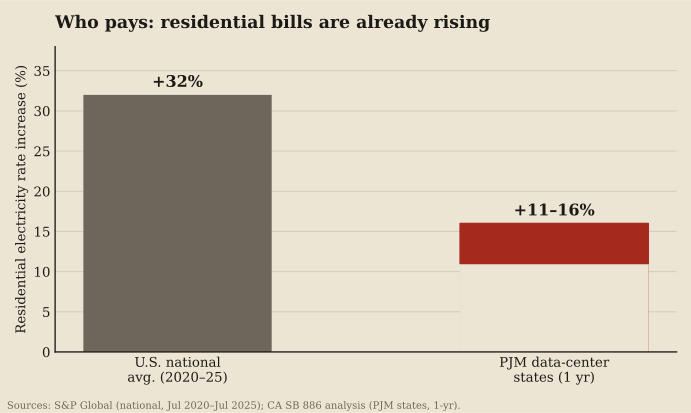
The default answer, absent intervention, is everyone else. This is "cost shifting," and it is already showing up in bills. U.S. residential electricity rates rose roughly 32% between July 2020 and July 2025 (S&P Global). In the PJM states with the heaviest data center concentration, single-year residential increases of 11–16% have been attributed in legislative analyses to data center load.
The principle that fixes this is cost causation: the customer that causes a cost should pay it. Every demand in §2.4 is, at bottom, an application of that one principle. Even the data centers' own regulators agree with it — when Dominion Energy testified to Virginia regulators about its large-load tariff, it stated the first goal was to ensure customers pay rates aligned to their cost causation, and the second was to protect against unrecovered costs (DELTa / CoBank).
2.2 The phantom-load problem: speculation on your grid
Before discussing protections, understand a hidden dynamic that strengthens your hand: a large and unknowable share of "data center demand" is not real. Developers chasing scarce grid capacity file the same project with multiple utilities simultaneously — "site shopping" — to see who can connect them fastest. The result is wildly inflated forecasts that pressure utilities (and ratepayers) to overbuild.
The evidence:
- Wood Mackenzie tracked 134 GW of proposed data centers across the U.S. in late 2025, up from 50 GW a year earlier (EUCI).
- ERCOT (Texas) reported a 300% year-over-year increase in interconnection requests in 2025 (EY).
- When AEP Ohio imposed a real large-load tariff in July 2025 — one that required developers to actually commit financially — its forecast large-load demand fell by more than half, from 30 GW to about 13 GW, and connection requests dropped by half. Analysts at Enverus described it bluntly: the tariff "cleared the queue" of speculative positions (EUCI; Independence Institute).
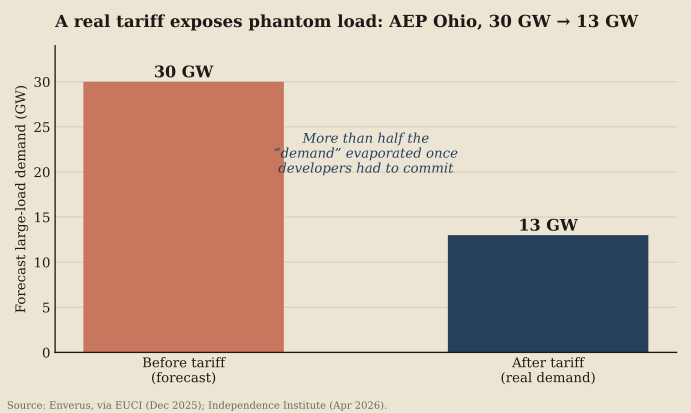
The lesson for your community: a strong tariff is not only a shield against cost-shifting — it is a filter that separates real projects from speculation. A developer unwilling to post collateral and sign a long minimum-take contract may not have a real project. (Note the cautionary flip side: AEP's forecast fell to 13 GW, but its $72 billion capital plan, originally justified by the inflated projection, did not shrink to match. Demand that utility capital plans be revised downward when speculative load washes out — otherwise ratepayers fund infrastructure for demand that never existed.)
2.3 The solution architecture: the large-load tariff
A large-load tariff is a specialized, legally binding set of rate and service rules for very large customers (the threshold is typically defined in MW — e.g., 25 MW, 50 MW, 75 MW). PUCs have authority to create them; legislatures can direct them to. Across the 77 filings in the DELTa database, the archetype blends three objectives (CoBank):
- Assign incremental costs to the requested load — to prevent cost shifting (the §2.1 principle).
- Lock in long contract terms and minimum bills — to reduce stranded-asset risk if the project shrinks or vanishes.
- Require credit, collateral, and clear exit rules — to make all of the above actually enforceable.
These are not theoretical. Here is what real, approved or proposed tariffs require as of mid-2026:
| Provision | Xcel Energy (CO) | AEP Ohio | Dominion (VA, GS-5) | Indiana Michigan Power | PPL / PA model (PUC) |
|---|---|---|---|---|---|
| Size threshold | 50 MW+ | Large load | 25 MW+, 75% load factor | Large load | Large load |
| Minimum contract term | 15 years | ~8–12 years* | 14 years | 12 years | Guidance set; ramp + exit rules |
| Load-ramp period | — | — | 4 years | 5 years | Addressed |
| Minimum bill / take | 80% of contracted demand | 85% of demand charge | 80% of contracted demand | 80% of contracted demand | Addressed |
| Exit fee | Sum of remaining minimum monthly bills | Early-exit penalties | If capacity cut >20% | If capacity cut >20%, with approved exit fee | Linked to min-load & security |
| Study deposit | ~$120,000 | Up to ~$100,000 (100 MW) | — | — | Deposits required |
| Collateral / security | ~6 months of operations | Security deposit | ~$1.5M per MW (or credit rating / parental guarantee) | Required | Sufficient to cover upgrade costs |
| Pays for own generation & transmission | Yes | Yes | Yes | Yes | Self-construction option allowed |
| Clean / emerging tech component | Yes (geothermal, long-duration storage) | — | — | — | — |
| Interconnection transparency | — | — | — | — | Public queue + 6-month studies |
*Sources differ on AEP Ohio's term length (reported as both 8 and 12 years); the 85% minimum demand charge is consistent across sources.
Two benchmark data points to keep in your pocket:
- A Tri-State Generation analysis of 11 large-load tariffs found the average security requirement was 7 years of minimum bills, in cash or letter of credit.
- Of the 77 DELTa filings, 44 include additional collateral requirements — collateral is now mainstream, not aggressive.
The rest of this chapter converts this architecture into a demand list you can take to your utility, your PUC, and your developer.
2.4 The demands: what to ask for, and why
Each demand below follows the same format — the ask, the justification, and the benchmark (a real precedent with numbers, so nobody can call your community's position radical). Together they constitute the energy annex of your community benefits agreement and your testimony at the PUC.
Demand 1 — Full incremental cost allocation ("cost-causer pays")
The ask: Every incremental cost of serving the facility — generation capacity, transmission, substations, distribution upgrades, interconnection studies — is allocated to the data center customer class, not socialized across residential and small-business ratepayers. Put it in the tariff and in the development agreement.
Justification: This is the foundational principle from which every other demand flows. Without it, the project is financed in part by an invisible tax on every electric bill in the region — the PJM experience ($2.2B → $14.7B in one year, ~2/3 from data centers) shows the scale. Columbia's Climate Law analysis states it plainly: a well-designed large-load tariff should fully allocate incremental system costs to the new large-load customers.
Benchmark: Oregon's cost-causer-pays overhaul ended an estimated $210M+ in annual ratepayer subsidies. Twenty-three states have approved at least one tariff built on this principle. Dominion's own testimony names cost-causation as goal one.
Demand 2 — Developer-funded grid infrastructure, in writing
The ask: The developer directly funds (or fully reimburses) all new generation, transmission lines, and substations required to serve the facility, with a written commitment that none of these costs will be recovered from other ratepayers — and an indemnification clause if a regulator later allocates them otherwise.
Justification: "We'll pay our fair share" is not a number. The March 2026 White House ratepayer pledge — in which major developers committed to pay for all new power-delivery infrastructure their projects require — establishes that the industry itself accepts this standard. Your community's job is to convert a voluntary pledge into a contract. (Note: analysts warn that outdated FERC transmission-pricing policy can undermine the pledge at the interstate level — Utility Dive — which is exactly why you need the obligation in your local agreement, not just in federal policy.)
Benchmark: Xcel Colorado's proposed tariff: data centers pay for all new generation they require and the transmission to connect, with prorated charges for shared upgrades. Pennsylvania's PUC model framework allows self-construction as an alternative — the customer builds it, the customer owns the cost.
Demand 3 — Minimum contract term (12–15 years)
The ask: A fixed minimum service term of no less than 12 years, ideally 15, between the utility and the data center.
Justification: Utilities finance infrastructure over decades. If the data center can walk away in year five — because the AI market turned, the operator was acquired, or chips made the facility obsolete — the remaining ratepayers inherit the mortgage on infrastructure nobody needs. Long terms convert the developer's confident projections into binding obligations. If they believe their own forecasts, signing should be easy; refusal tells you the project is speculative.
Benchmark: Xcel CO: 15 years. Dominion VA: 14 years. Indiana Michigan Power: 12 years. Colorado PUC guiding principles: minimum 15 years.
Demand 4 — Minimum take / minimum monthly bill (80–85% of contracted demand)
The ask: The customer pays for at least 80–85% of its contracted capacity every month, whether or not it uses it ("take-or-pay").
Justification: This is the anti-bluff clause. It makes the developer's own demand forecast financially binding, protects the utility's revenue requirement (so other ratepayers don't backfill shortfalls), and — critically — deflates the inflated MW numbers developers use to justify subsidies and rezonings. A developer who demands 300 MW of capacity but resists paying for 240 MW of it has told you their real number.
Benchmark: Xcel CO and Indiana: 80% of contracted demand. AEP Ohio: 85%. Virginia GS-5 applies to customers with a 75% load factor — i.e., the class is defined by high steady usage.
Demand 5 — Exit fees with teeth
The ask: Early termination or material downsizing (e.g., reducing contracted capacity by more than 20%) triggers a fee equal to the remaining minimum bills on the contract — or a comparable formula that makes ratepayers whole.
Justification: Stranded-asset risk is the nightmare scenario: policy analyses now explicitly warn of communities left holding infrastructure debt if the AI investment bubble deflates (Sierra Club, 2026 state policy review). The exit fee is the instrument that transfers that risk back to the party who created it. It also compounds the speculation filter — phantom projects won't sign.
Benchmark: Xcel CO: exit fee equals the sum of all remaining minimum monthly bills on the 15-year term. Colorado PUC principles contemplated 75% of all electricity the facility would have used over the full contract life. Indiana: exit fee on any capacity reduction beyond 20%. PPL (PA): exit fees linked to minimum-load and security provisions.
Demand 6 — Collateral, creditworthiness, and a real counterparty
The ask: (a) Collateral or a letter of credit sufficient to cover the infrastructure built for the project — benchmark $1.5M per MW or several years of minimum bills; (b) where the applicant is a shell LLC, a parental guarantee from the creditworthy ultimate parent; (c) disclosure of that parent as a condition of service.
Justification: Every protection in this chapter is worthless against an empty LLC. Data center projects are routinely developed through single-purpose entities; if the project fails, the LLC dissolves and the obligations dissolve with it. Collateral and parental guarantees are how the industry itself manages counterparty risk — your community should get the same protection Wall Street demands.
Benchmark: Dominion VA: $1.5 million per MW in collateral for the 14-year term, waivable only for an acceptable credit rating or a qualified parental guarantee. Tri-State's analysis of 11 tariffs: average security equal to 7 years of minimum bills, in cash or letter of credit. 44 of the 77 filings in the DELTa database include collateral requirements — this is now the mainstream.
Demand 7 — Non-refundable study deposits
The ask: A substantial non-refundable deposit ($100,000–$250,000+) before the utility performs interconnection and system-impact studies.
Justification: Site-shopping is free for developers and expensive for everyone else — every speculative application consumes utility planning resources and inflates the forecasts used to justify new plants. A real deposit makes filing the same project in five states simultaneously costly. AEP Ohio's experience proves the effect: requiring real financial commitment cut connection requests in half.
Benchmark: Colorado PUC principles: $250,000. Xcel's filed proposal: ~$120,000. AEP Ohio: up to ~$100,000 for a 100 MW facility.
Demand 8 — Defined load-ramp schedules
The ask: A contractual schedule by which the facility ramps to full contracted load (typically 4–5 years), with minimum bills applying along the ramp.
Justification: Without a ramp schedule, the developer enjoys a free option: reserve a gigawatt of capacity, build a tenth of it, and decide later. The reservation itself blocks other economic development and drives utility planning. Ramp schedules with payments attached make capacity reservation a priced commitment rather than a free lottery ticket.
Benchmark: Dominion VA: 4-year ramp inside a 14-year term. Indiana: up to 5 years inside a 12-year term.
Demand 9 — Capital-plan true-down when phantom load evaporates
The ask: When tariffs or attrition cut the utility's large-load forecast, the utility's rate-base capital plan must be revised downward accordingly — and your local government should intervene at the PUC to insist on it.
Justification: This is the lesson of the AEP Ohio cautionary tale: forecast demand fell from 30 GW to 13 GW once the tariff bit, but the $72 billion capital plan justified by the original 30 GW did not shrink to match (Independence Institute). If the plan isn't trued down, ratepayers fund infrastructure for demand that never existed — cost-shifting through the back door after you locked the front.
Benchmark: This demand is newer than the others, which is exactly why local intervention matters; Pennsylvania's public-queue transparency requirement (below) creates the data needed to police it.
Demand 10 — No induced fossil generation; clean-energy sourcing
The ask: (a) The facility's load may not be met by new or life-extended fossil generation; (b) a clean transition tariff (CTT) or equivalent requiring the customer to procure new zero-carbon supply (with storage) matched to its load; (c) explicit limits on utility "backsliding" — reviving retiring coal/gas plants to serve the load.
Justification: Columbia's framework names this the second pillar of a well-designed tariff: ensuring load growth does not induce new fossil generation. Beyond climate, this is a cost protection — fossil peakers built for data center load become tomorrow's stranded assets on ratepayers' books, and (per Part 3) fossil generation is also the hidden bulk of data center water consumption: roughly 211 billion gallons of indirect water use in 2023 versus 17 billion direct.
Benchmark: Xcel CO's tariff includes a clean transition component targeting geothermal and long-duration storage. CTTs are an established mechanism in PUC practice (Columbia Climate Law Blog, June 2026).
Demand 11 — Demand flexibility and curtailment obligations
The ask: The facility must (a) curtail load on utility instruction during grid emergencies, and (b) enroll a defined share of its load (10–25%) in demand-response programs — with curtailment capability verified annually.
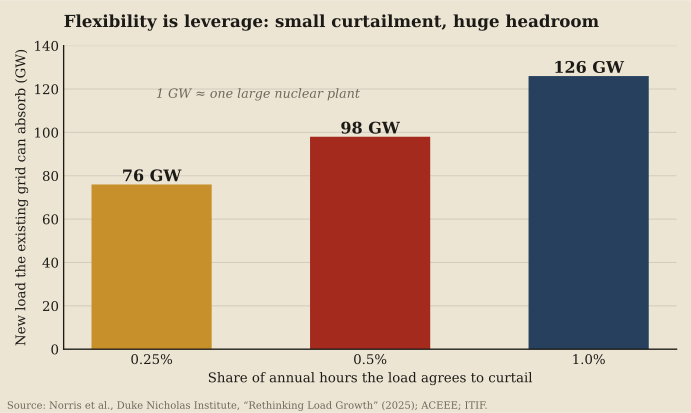
Justification: This is the highest-leverage technical demand in the chapter, and the research behind it is robust. Duke University's Nicholas Institute found the existing U.S. grid could absorb roughly 76 GW of new load if those loads curtailed just 0.25% of annual hours — and ~98–126 GW at 0.5–1% — average curtailment events of about two hours, well within battery capability. Carbon Direct's ERCOT modeling shows data center demand response can eliminate forced-blackout risk even at 40 GW of buildout, preventing an estimated $5.5 billion per year in consumer welfare losses. And it is operationally proven: an Oracle facility in Phoenix cut peak draw 25% in real time without degrading AI compute; Google runs event-based load reduction with Duke Energy in North Carolina; Emerald AI has demonstrated 25% curtailment without GPU service interruption. A developer who claims curtailment is impossible is several years behind their own industry.
Benchmark: Texas SB 6 (signed June 2025) requires new loads above 75 MW connecting to ERCOT to demonstrate curtailment capability during declared emergencies. DOE analysis notes utilities can serve data center load ~350 days a year — it's the ~15 peak days that strain the grid, which is precisely what flexibility solves. Flexibility is also the developer's own carrot: flexible loads get connected faster.
Demand 12 — Rules for behind-the-meter and backup generation
The ask: (a) Any on-site generation (gas turbines, fuel cells, diesel beyond emergency backup) is treated as a separately permitted industrial power plant with emissions limits, run-hour caps, and noise conditions; (b) co-located generation does not exempt the facility from tariff obligations for its grid-connected load; (c) backup diesel fleets carry air permits, testing schedules, and public reporting.
Justification: As interconnection queues lengthen, developers increasingly propose on-site gas generation to bypass the grid entirely — converting a "data center" into an unregulated power plant next to your neighborhoods. Hybrid grid-plus-on-site configurations are accelerating industry-wide (EY). Without explicit rules, every protection you negotiated for grid service can be evaded by self-supply. Colorado's PUC explicitly directed its tariff process to address how co-located generation affects cost allocation — your agreement should too.
Benchmark: Maryland's HB 120 ties data center approval to co-location rules for new generation. Air-district permitting of diesel fleets is standard practice in Northern Virginia.
Demand 13 — Interconnection transparency: the public queue
The ask: The serving utility maintains a public-facing list of all large-load interconnection applications — date, location (zip), requested MW, and study stage — and completes interconnection studies on a defined timeline (six months).
Justification: Secrecy is the developer's structural advantage (Part 1, §1.5). A public queue lets your community see the real pipeline of projects targeting your grid before any one of them reaches a hearing — and lets you detect site-shopping and phantom load directly. It also disciplines the utility's forecasting (Demand 9).
Benchmark: Pennsylvania's first-of-its-kind PUC model tariff framework (final order, May 13, 2026) requires exactly this: a dedicated public website at each utility listing large-load applications by date, zip code, MW, and interconnection stage, plus six-month study timelines.
Demand 14 — Efficiency standards, reporting, and audit rights
The ask: (a) A contractual maximum PUE at full buildout (e.g., ≤1.3, against an industry average of 1.56 and best-in-class ~1.09); (b) annual public reporting of energy consumption, peak demand, PUE, curtailment performance, and on-site generation run-hours; (c) community audit rights at developer expense.
Justification: What isn't measured isn't enforceable, and what isn't public isn't accountable. Efficiency requirements directly shrink every other impact in this handbook — energy, water (cooling is 30–40% of facility load), emissions, and noise. ACEEE's policy review identifies efficiency and flexibility targets — voluntary, mandatory, or rate-linked — as the lowest-cost tools states have barely begun to use.
Benchmark: EU regulation already mandates data center energy reporting; several U.S. states' 2026 bills include consumption disclosure. The NAACP CBA template's independent-expert and monitoring provisions supply the audit architecture.
Demand 15 — Standing: your seat at the PUC
The ask: (a) Your local government formally intervenes in every rate case and tariff proceeding affecting service to the facility; (b) the development agreement requires the developer to support (or at minimum not oppose) application of the state's large-load tariff to the project; (c) where no tariff exists, the agreement requires the developer to take service under terms no weaker than the benchmarks in this chapter.
Justification: The PUC is where the real money moves, and PUC proceedings are decided by who shows up. Communities have full legal standing to intervene — and almost never do. A developer's willingness to accept this clause is the single fastest test of good faith: a company that intends to pay its own costs loses nothing by agreeing.
Benchmark: At least 18 states have introduced large-load rate-class legislation (ArentFox Schiff); 23 states have approved tariffs with 7 pending (EEI). The tools exist. Standing is how your community picks them up.
2.5 Where each fight happens: the jurisdiction map
| Venue | What's decided there | Your tools |
|---|---|---|
| City / county board | Rezoning, CUP conditions, development agreement, CBA | Demands 2, 6, 10, 11, 12, 14, 15 as contract terms; deny or condition approval |
| State PUC / PSC | Large-load tariffs, rate cases, cost allocation, CTTs | Formal intervention; testimony; Demands 1, 3–9, 13 |
| State legislature | Tariff mandates, moratoria, disclosure laws, incentive reform | Support model bills (18+ states active); oppose preemption of local authority |
| Water & air districts | Generation permits, diesel fleets | Demand 12 |
| FERC / RTO (PJM, ERCOT, MISO…) | Interstate transmission cost allocation, capacity markets | Comment through coalitions; the venue where the White House pledge can be undermined or enforced |
Sequencing matters. The development agreement is your only leverage over the developer; the PUC is your only leverage over the utility. Get the developer's tariff-support and ratepayer-indemnity commitments into the agreement before approval — afterward, your leverage at city hall is gone and only the PUC route remains.
2.6 The asks at a glance
| # | Demand | Benchmark figure | Primary venue |
|---|---|---|---|
| 1 | Full incremental cost allocation | 23 states' tariffs; OR ended $210M+/yr subsidy | PUC + agreement |
| 2 | Developer-funded grid infrastructure | Xcel CO; White House pledge as floor | Agreement |
| 3 | Minimum contract term | 12–15 yrs (IN/VA/CO) | PUC tariff |
| 4 | Minimum take / minimum bill | 80–85% of contracted demand | PUC tariff |
| 5 | Exit fees | Sum of remaining minimum bills (Xcel CO) | PUC tariff |
| 6 | Collateral + parental guarantee | $1.5M/MW (Dominion); avg 7 yrs of min bills | Tariff + agreement |
| 7 | Study deposits | $100k–$250k | PUC tariff |
| 8 | Load-ramp schedule | 4–5 years | PUC tariff |
| 9 | Capital-plan true-down | AEP: 30→13 GW but $72B plan unchanged | PUC intervention |
| 10 | No induced fossil; clean transition tariff | Xcel CO clean component | PUC + agreement |
| 11 | Curtailment & demand response | TX SB 6 (75 MW+); Duke 76–126 GW headroom | Tariff + agreement |
| 12 | Behind-the-meter generation rules | MD HB 120; air-district permits | Agreement + districts |
| 13 | Public interconnection queue, 6-mo studies | PA PUC model framework (May 2026) | PUC |
| 14 | PUE cap + public reporting + audit | PUE ≤1.3 vs 1.56 industry avg | Agreement |
| 15 | PUC intervention + developer tariff support | 18 states' bills; 23 approved tariffs | All venues |
2.7 References
Tariff design and precedents
- Columbia Climate Law Blog, "Data Center Regulation: What Local Governments Should Know about Large-Load Tariffs and Clean Transition Tariffs," June 2, 2026. https://blogs.law.columbia.edu/climatechange/2026/06/02/data-center-regulation-what-local-governments-should-know-about-large-load-tariffs-and-clean-transition-tariffs/
- CoBank / SEPA / NC Clean Energy Technology Center, "The state of large load rate design: Insights from the DELTa database" (data: March 2026). https://www.cobank.com/knowledge-exchange/power-energy-and-water/a-guide-for-serving-large-loads/the-state-of-large-load-rate-design-insights-from-the-delta-database
- Pennsylvania PUC, "Final Order Establishing First-of-Its-Kind Large Load Model Tariff Framework," May 13, 2026. https://www.puc.pa.gov/press-release/2026/puc-releases-final-order-establishing-first-of-its-kind-large-load-model-tariff-framework-05132026
- Colorado Sun, "Xcel proposes new rate scale for data centers to shield consumers," April 2, 2026. https://coloradosun.com/2026/04/02/data-centers-xcel-energy-colorado-rate-tariff-consumers/
- Independence Institute, "Xcel Energy Proposes Large-Load Tariff for Data Centers," April 9, 2026 (includes AEP Ohio capital-plan critique). https://i2i.org/xcel-energy-proposes-large-load-tariff-for-data-centers/
- Utility Dive, "Adapting utility tariffs for data center driven load growth," July 2025 (Indiana & Virginia GS-5 details). https://www.utilitydive.com/spons/adapting-utility-tariffs-for-data-center-driven-load-growth/752706/
- EUCI, "Utilities adopt large load tariffs to cope with the costs and power demands of data centers," Dec 2025 (AEP Ohio terms; Wood Mackenzie 134 GW; Tri-State security analysis). https://www.euci.com/utilities-adopt-large-load-tariffs-to-cope-with-the-costs-and-power-demands-of-data-centers/
- Davis Graham, "Federal and Colorado Action on Data Centers and Large Power Loads," Feb 2026. https://davisgraham.com/news-events/federal-and-colorado-action-on-data-centers-and-large-power-loads/
- ArentFox Schiff, "State Regulation of Data Centers in 2026 – A Shifting Landscape," April 2026. https://www.afslaw.com/perspectives/alerts/state-regulation-data-centers-2026-shifting-landscape
Cost-shifting evidence
- Brookings Institution (Bahar & Wright), "New evidence on data center employment effects," May 2026 (PJM $2.2B→$14.7B; rate data). https://www.brookings.edu/articles/new-evidence-on-data-center-employment-effects/
- IEEFA, "Projected data center growth spurs PJM capacity prices." https://ieefa.org/resources/projected-data-center-growth-spurs-pjm-capacity-prices-factor-10
- S&P Global Market Intelligence, "US data center regulations emerge amid efforts to ease electricity rate concerns," Dec 2025.
- Consumer Reports, "AI Data Centers: Big Tech's Impact on Electric Bills, Water, and More," March 2026. https://www.consumerreports.org/data-centers/ai-data-centers-impact-on-electric-bills-water-and-more-a1040338678/
- Sierra Club, "Data Center State Policies, 2026" (stranded-asset and minimum-take analysis). https://www.sierraclub.org/sites/default/files/2026-01/policies-for-data-centers-2026.pdf
- Utility Dive, "An outdated FERC policy is undermining the White House's ratepayer protection pledge," April 2026. https://www.utilitydive.com/news/ferc-transmission-policy-white-house-ratepayer-protection-peskoe/815438/
Flexibility and efficiency
- Norris et al., Duke University Nicholas Institute, "Rethinking Load Growth: Assessing the Potential for Integration of Large Flexible Loads in US Power Systems," Feb 2025. https://www.utilitydive.com/news/us-grid-headroom-flexible-load-data-center-ai-ev-duke-report/739767/
- Carbon Direct, "The billion-dollar case for enabling data center load flexibility," March 2026 (ERCOT modeling; Texas SB 6; Emerald AI). https://www.carbon-direct.com/insights/the-billion-dollar-case-for-enabling-data-center-load-flexibility
- ACEEE, "Opportunities to Use Energy Efficiency and Demand Flexibility to Reduce Data Center Energy Use and Peak Demand" (Oracle Phoenix; Google/Duke Energy; EPRI DCFlex). https://www.aceee.org/sites/default/files/pdfs/opportunities_to_use_energy_efficiency_and_demand_flexibility_to_reduce_data_center_energy_use_and_peak_demand.pdf
- EY, "Demand response and data center growth," April 2026 (ERCOT 300% queue growth; DOE 15-peak-days analysis). https://www.ey.com/en_us/insights/power-utilities/demand-response-and-data-center-growth
- ITIF, "The United States Needs Data Centers...," Nov 2025 (76–126 GW headroom range). https://itif.org/publications/2025/11/24/united-states-needs-data-centers-data-centers-need-energy-but-that-is-not-necessarily-a-problem/
All tariff terms current as of June 2026 and drawn from filed or approved proceedings; terms are modified in litigation and settlement constantly — pull the current tariff sheet from your utility's PUC docket before citing numbers in testimony.