
Part 6: Jobs & Economic Justice
"Jobs" is the word that wins data center approvals — and the promise most often inflated, most rarely verified, and most easily captured by workers who live three states away. The work is real and well-paid; the question is whether your community gets it. This chapter separates the honest jobs story from the marketing, and lays out the twelve demands that turn a headline number into paychecks for local people.
6.0 The jobs question, honestly
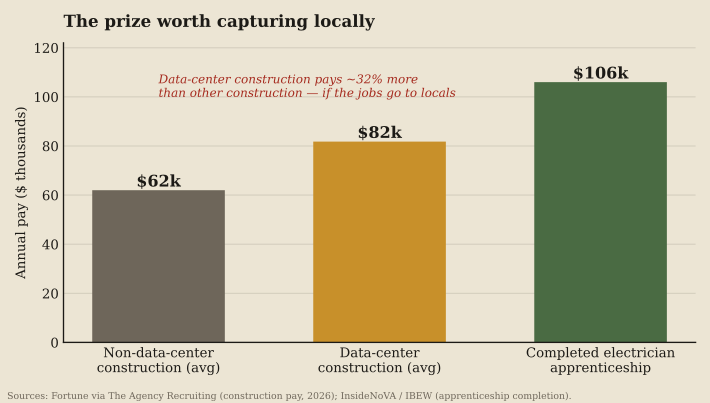
Every data center proposal leads with jobs, and a handbook that simply waved the number away would be as dishonest as the brochures. The work is genuine: data center construction pays roughly 32% more than other construction, and a completed electrician apprenticeship can clear $106,000 a year (The Agency Recruiting; InsideNoVA). These are real, life-changing wages.
But two failure modes turn that promise hollow, and this chapter is built around defeating both:
- Overcounting. Temporary construction jobs get presented as permanent; rigorous estimates of the lasting employment effect are roughly one-third of what industry studies claim (Brookings, May 2026; Part 1). A community that prices an incentive on an inflated number (Part 5) overpays for jobs that never materialize.
- Leakage. Even real jobs can be captured by traveling specialty crews and remote contractors, leaving the host community with the impacts and someone else with the paychecks. The single largest determinant of local benefit is not how many jobs exist but how many go to local people — and that is a contractual choice, not an accident.
The good news is that the national labor shortage hands communities unusual leverage. Operators cite workforce shortages as the top risk to expansion (JLL: 68% of operators), which means a community offering an organized local pipeline is giving the developer something it badly needs — and can demand real commitments in return.
6.1 The two job streams
A data center produces two completely different kinds of employment, and conflating them is the root of most jobs deception.
Construction jobs: many, brief, well-paid. A large hyperscale build employs 1,000–2,500 workers at peak, for roughly two to three years. The pay is excellent — data center construction workers average about $81,800 versus $62,000 on other builds, and electricians in hot markets like Northern Virginia and Texas report $120,000–$280,000 (The Agency Recruiting; iRecruit). Electrical work alone is 45–70% of construction cost (IBEW). This is a genuine economic event — but a temporary one.
Operations jobs: few, permanent, specialized. Once built, the facility runs on a skeleton crew — typically 10–50 permanent staff for a large site (Part 1). These last for decades, but there are very few of them.
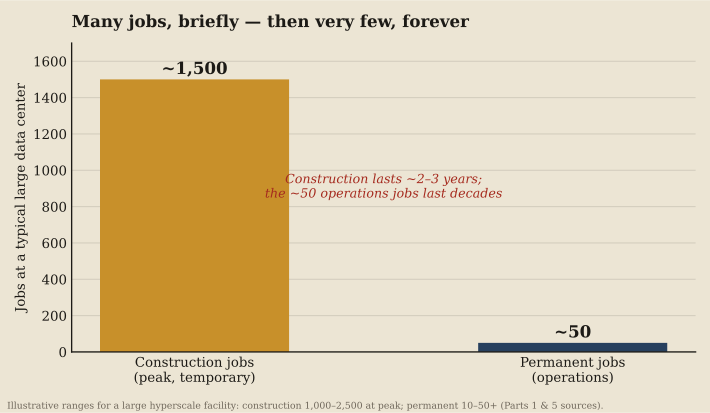
Plotted over time, the asymmetry becomes a cliff: a multi-year construction spike, then a collapse to a thin permanent line that runs for the life of the facility.
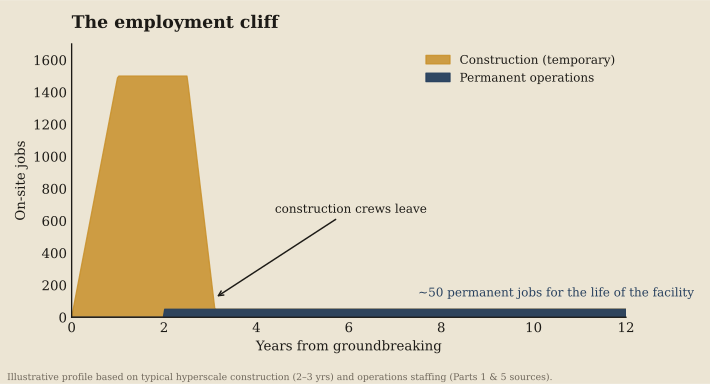
Neither stream is bad. But they require completely different demands: construction jobs are protected by prevailing wage, project labor agreements, and local-hire targets (Demands 3–5); permanent jobs are protected by FTE commitments with clawbacks and quality floors (Demands 2, 8). A proposal that blurs the two is hiding the cliff.
6.2 The honest-accounting problem
The most common jobs deception is arithmetic: counting the construction spike as if it were permanent employment, or citing "job-years" and "supported jobs" that quietly fold in temporary and indirect figures.
The rigorous corrective is the Brookings 2026 synthetic-control study (Part 1): counties receiving their first large data center see total private employment rise 4–5% over five to six years, with wages up 3–4% — but naive estimates overstate the effect by a factor of three, because data center counties were already growing faster than their peers before the facility arrived. Industry-sponsored impact studies use exactly that naive method.
This connects directly to Part 5's cost-per-job math. When the jobs number is inflated threefold and the incentive is priced against it, the community overpays threefold. The defense is definitional: require that construction and permanent jobs be reported as separate, clearly defined quantities — construction in job-months at peak and total, permanent in full-time-equivalents at full buildout — with no "supported," "induced," or "job-year" figures substituted for headcount in any public document (Demand 1). Honest accounting is not hostile to the project; it simply prices the deal correctly.
6.3 Who actually gets the jobs
A real job in your county that goes to a worker from another state is, for your community, not a benefit — it's traffic. Specialty trades on compressed data center timelines are routinely staffed by traveling crews unless an agreement requires otherwise. The wages are the prize worth fighting to keep local.
Two facts make local capture achievable rather than aspirational:
The shortage is real and structural. The industry needs up to 499,000 additional construction workers in 2026, with 41% of the current workforce retiring by 2031, and the U.S. needs roughly 300,000 new electricians this decade on top of 200,000 retirements (iRecruit; IBEW). Operators are desperate for labor — which is precisely why a community that builds a pipeline holds leverage.
The pipeline model is proven. In Prince William County, IBEW Local 26's registered apprenticeship has put nearly 1,000 members onto data center projects, and the DMV-area electricians' union doubled its membership to 14,700 between 2018 and early 2026 to meet demand — apprentices starting around $26/hour and reaching $106,000 on completion (InsideNoVA). Registered apprentices nationally start near $77,000 and are retained by their sponsor 93% of the time (DOL via Data Center Geeks). The mechanism for turning the construction spike into local careers already exists; the community's job is to require its use (Demands 4–6).
6.4 The pipeline that works
The successful models share a structure communities can demand and replicate:
Registered apprenticeship and PLAs. A project labor agreement requires all contractors — union and non-union — to pay prevailing wage, hire locally, fund training, and support apprenticeship, with dispute resolution and no-strike terms that also protect the developer's schedule (Metropolitan Water District PLA). Prevailing-wage law (Davis-Bacon federally; state "little Davis-Bacon" acts) prevents contractors from underbidding by cutting local wages, with debarment for violators (DOL).
Community-college academies. The operators themselves have built the template: Microsoft's Datacenter Academy spans 50+ community colleges across 15+ states; AWS partners with Columbus State Community College (with scholarships) and Per Scholas; Google's Data Center Academy and STAR skilled-trades pathway operate across Virginia and Ohio; Oracle runs apprenticeships through its Columbus campus. Google's Lithia Springs, Georgia site has hired directly from Chattahoochee Technical College for over a decade (Data Center Geeks; Columbus State; Google). These are not favors — they are workforce pipelines the operators need. A community should require that the academy be built with local institutions, for local residents, not imported.
Pre-apprenticeship and first-source hiring. The gap between a displaced or entry-level local worker and an apprenticeship slot is bridged by pre-apprenticeship programs and "first-source" hiring agreements that route openings to local job centers first (New America; DOL career pathways). This is where economic-justice goals become concrete.
6.5 Economic justice: capturing the benefit where the burden lands
The communities asked to host data center impacts — and disproportionately, as Part 4 showed, lower-income and minority communities — should be the communities that capture the jobs. Three mechanisms:
Targeted hiring. Local-hire targets sharpened with priority for residents of the most affected neighborhoods, returning citizens, veterans, and workers from disadvantaged backgrounds — backed by the pre-apprenticeship pipeline that makes the targets reachable.
Local business and supply chain. Construction spends hundreds of millions; a local-business utilization target (a share of contracts to local small, minority-, and women-owned firms) keeps that spending in the community. Community-benefit programs elsewhere track exactly this — work awarded to local small and medium enterprises, apprenticeship weeks, training hours — as auditable metrics (Fife CB case study).
Benefit commensurate with burden. Where a facility sits in an already-overburdened community (Part 4) or receives public subsidy (Part 5), the workforce commitments should be proportionally stronger — because the community is accepting more and should receive more. This is the jobs expression of the equity principle that runs through the whole handbook.
6.6 The demands: what to ask for, and why
Same format: the ask, the justification, the benchmark.
Demand 1 — Honest, separated job accounting
The ask: All public materials report construction and permanent jobs as distinct, defined quantities — construction as peak and total job-months, permanent as full-time-equivalents at full buildout — with no "supported," "induced," or "job-year" figures substituted for actual headcount, and all definitions written into the agreement.
Justification: Conflating temporary construction with permanent operations is the foundational jobs deception, and it directly inflates the cost-per-job math that prices incentives (Part 5). Brookings found industry methods overstate employment effects threefold. Honest definitions don't kill the project; they price it correctly.
Benchmark: The Brookings synthetic-control methodology as the standard for honest estimation; Good Jobs First's insistence on verified job definitions in subsidy MOUs.
Demand 2 — A permanent FTE commitment with clawbacks
The ask: A binding minimum permanent full-time-equivalent count at full buildout, with wage and benefit floors, and automatic recoupment of incentives if the facility underdelivers — tied to the Part 5 clawback structure.
Justification: Permanent jobs are few, so each promised one should be guaranteed. The JPMorgan facility that promised 5 jobs, and data centers that delivered fractions of projections (Part 5), are why "trust us" is not a commitment. A number without a clawback is a wish.
Benchmark: Nevada's statutory clawback tied to job thresholds; Good Jobs First's required clawback provisions.
Demand 3 — Local-hire targets for construction and operations
The ask: Percentage local-hire targets for both construction (by trade) and permanent positions, defined by a real labor-market radius, with a good-faith implementation plan, first-source referral to local job centers, and verification by residency — not just a vague "we'll prioritize locals."
Justification: A job that goes to an out-of-state traveling crew is not a local benefit. Local capture is a contractual choice; the labor shortage gives communities the leverage to require it. Without residency verification, "local hiring" is unmeasurable and therefore unenforceable.
Benchmark: PLA local-hire requirements (Metropolitan Water District); first-source hiring agreements routing openings to local one-stops (New America/DOL).
Demand 4 — Prevailing wage and a project labor agreement
The ask: Prevailing-wage requirements on all construction, and a project labor agreement covering the build — requiring local hire, training, apprenticeship, dispute resolution, and no-strike terms.
Justification: Prevailing wage prevents contractors from underbidding by cutting local pay and importing cheaper crews (DOL); a PLA bundles wage, local-hire, training, and apprenticeship protections while also giving the developer schedule certainty through no-strike and dispute-resolution clauses — a genuine mutual benefit on the compressed timelines data centers run.
Benchmark: Davis-Bacon and state "little Davis-Bacon" acts; the Metropolitan Water District PLA model (prevailing wage + local hire + apprenticeship + dispute resolution).
Demand 5 — Registered-apprenticeship utilization
The ask: A minimum share of construction hours performed by registered apprentices, with defined apprentice-to-journeyworker ratios and sponsorship commitments that outlast the single project.
Justification: Apprenticeship is the mechanism that converts a temporary construction spike into permanent local careers — IBEW Local 26 put ~1,000 members onto data center work this way, with apprentices reaching $106,000 on completion and 93% retained nationally (InsideNoVA; DOL). Apprentice utilization requirements ensure the build trains the next generation of local tradespeople, not just out-of-town veterans.
Benchmark: IBEW Local 26 / Prince William County; registered DOL apprenticeship standards; PLA apprenticeship clauses.
Demand 6 — Fund a local workforce pipeline
The ask: Developer funding for a workforce-training pipeline built with local institutions for local residents — a community-college data center academy, pre-apprenticeship programs, and scholarships — with enrollment and placement targets, not a one-time donation.
Justification: The operators have already proven this model works (Microsoft Datacenter Academy across 50+ colleges; AWS/Columbus State; Google STAR; Lithia Springs hiring from Chattahoochee Technical College). The demand is simply that the pipeline be local and durable rather than imported or symbolic — turning the developer's own workforce need into a community asset.
Benchmark: Microsoft Datacenter Academy; AWS–Columbus State; Google Data Center Academy/STAR; Oracle Pathways.
Demand 7 — Targeted and equitable hiring
The ask: Within the local-hire targets, priority for residents of the most affected neighborhoods, returning citizens, veterans, and workers from disadvantaged backgrounds, supported by pre-apprenticeship on-ramps and removal of unnecessary barriers (e.g., overbroad background screens).
Justification: The communities that bear the impacts — disproportionately lower-income and minority (Part 4) — should capture the jobs. Targets without on-ramps are empty; pre-apprenticeship is what makes equitable hiring reachable rather than rhetorical.
Benchmark: DOL career-pathway models; first-source and targeted-hire provisions in major-project community-benefit agreements.
Demand 8 — Job-quality floors and anti-evasion
The ask: Wage and benefit floors for permanent positions; full-time, directly-employed status for core operations roles; safety standards; and prohibition on misclassifying or contracting-out permanent jobs to evade the FTE commitment and quality floors.
Justification: A permanent-jobs commitment is meaningless if the jobs are subcontracted, part-time, or stripped of benefits. Quality floors and anti-evasion language ensure the few permanent jobs are good ones — and that the headcount commitment can't be gamed through outsourcing.
Benchmark: Prevailing-compensation standards; community-benefit job-quality provisions.
Demand 9 — Local business and supply-chain utilization
The ask: Targets for the share of construction and operations contracts awarded to local small, minority-, women-, and veteran-owned businesses, with reporting on dollars awarded.
Justification: Construction spends hundreds of millions; keeping a defined share in local firms multiplies the community benefit well beyond direct wages. Community-benefit programs routinely track local-SME contract value as an auditable metric (Fife CB case study).
Benchmark: Local-business utilization targets in public-works community-benefit agreements.
Demand 10 — Transparent workforce reporting and audit
The ask: Annual public reporting of actual hires by residency, trade, wage, apprenticeship status, demographic category, and local-business contract dollars — with community audit rights at developer expense.
Justification: Every target in this chapter is unenforceable without verified data. Self-reported, unaudited numbers are the workforce equivalent of the self-reported emissions in Part 4 — not oversight. Public reporting also lets the community course-correct mid-build rather than discovering shortfalls after completion.
Benchmark: Good Jobs First's reporting framework; the auditable community-benefit metrics in established CBA reporting.
Demand 11 — No public subsidy without enforceable job conditions
The ask: Any incentive (Part 5) is contingent on the workforce commitments in this chapter — local-hire, wage, apprenticeship, and FTE targets — with the same clawbacks attached.
Justification: This is the hinge between Parts 5 and 6: subsidies are justified publicly by jobs, so the jobs must be guaranteed in exchange for the money. Granting incentives on the promise of employment, with no enforceable condition, is how communities end up at $1–6 million per job (Part 5).
Benchmark: Good Jobs First model subsidy reforms conditioning exemptions on jobs, wages, benefits, and clawbacks.
Demand 12 — Standing, a workforce board, and shortfall remedies
The ask: Residents named as third-party beneficiaries of the workforce commitments; a standing labor/workforce oversight board (with local trades, educators, and community representatives) meeting at least annually; and defined remedies — fees, clawbacks, or accelerated local-hire obligations — for missed targets.
Justification: Part 1's enforcement rule, applied to jobs: targets without teeth are press releases. A standing board converts a one-time promise into ongoing accountability and gives the community a seat at the table for the life of the project.
Benchmark: Community-workforce-agreement oversight boards; the NAACP CBA template's community-oversight provisions.
6.7 Where each fight happens
| Venue | What's decided there | Your tools |
|---|---|---|
| City / county board (zoning, CUP, CBA) | Local-hire, apprenticeship, training, business targets, FTE commitment | Demands 1–3, 5–10, 12 as conditions of approval |
| State econ-dev agency / IDA | Incentive-linked job and wage conditions, clawbacks | Demands 2, 11 |
| Labor / contracting (PLA negotiation) | Prevailing wage, PLA terms, apprenticeship ratios | Demands 4, 5 — bring the building trades to the table |
| Community college / workforce board | Training academy, pre-apprenticeship, first-source hiring | Demand 6, 7 |
| State legislature | Prevailing-wage law, apprenticeship standards, subsidy-job conditions | Support wage and disclosure law |
Sequencing: workforce terms must be set before approval and before incentives are granted — once the rezoning passes and the abatement is signed, the developer has no reason to accept local-hire or apprenticeship conditions. Bring the building trades and the community college into the negotiation from the start; they are allies with both expertise and leverage.
6.8 The asks at a glance
| # | Demand | Benchmark | Primary venue |
|---|---|---|---|
| 1 | Honest, separated job accounting | Brookings methodology; GJF | Board (pre-vote) |
| 2 | Permanent FTE commitment + clawbacks | Nevada clawback; GJF | Agency + agreement |
| 3 | Local-hire targets (construction + ops) | PLA local hire; first-source | Board + PLA |
| 4 | Prevailing wage + project labor agreement | Davis-Bacon; MWD PLA | PLA + agreement |
| 5 | Registered-apprenticeship utilization | IBEW Local 26; DOL standards | PLA + agreement |
| 6 | Fund a local workforce pipeline | Microsoft/AWS/Google academies | College + agreement |
| 7 | Targeted and equitable hiring | DOL pathways; CBA targeted hire | Board + workforce board |
| 8 | Job-quality floors + anti-evasion | Prevailing compensation; CBA quality terms | Agreement |
| 9 | Local business / supply-chain targets | Public-works LBE targets | Agreement |
| 10 | Transparent reporting + audit | GJF reporting; CBA metrics | Agreement |
| 11 | No subsidy without job conditions | GJF subsidy reforms | Agency + legislature |
| 12 | Standing + workforce board + remedies | NAACP template; CWA boards | Agreement |
6.9 References
The honest jobs picture
- Bahar & Wright, Brookings Institution, "New evidence on data center employment effects," May 2026 (4–5% employment; 3x overstatement; wages +3–4%; hyperscale vs colocation; clusters). https://www.brookings.edu/articles/new-evidence-on-data-center-employment-effects/
- Policy Matters Ohio, "Indefensible tax breaks for data centers will cost Ohio," 2025 (jobs vs investment). https://policymattersohio.org/research/indefensible-tax-breaks-for-data-centers-will-cost-ohio/
Construction labor, wages, and shortage
- The Agency Recruiting, "2026 Construction Pay Trends: Data Center Wage Growth" (32% premium; $81,800 vs $62,000; electrician $140k–$280k). https://www.theagencyrecruiting.com/insights/2026-construction-pay-growth
- iRecruit, "Data Center Construction Labor Report" (up to 499,000 workers needed 2026; 41% retiring by 2031; DMV union doubling to 14,700). https://www.irecruit.co/insights/data-center-construction-labor-market-report
- The Birm Group, "Data Center Construction Hiring 2026" (compressed timelines; specialized-role pressure). https://thebirmgroup.com/data-center-construction-boom-2026/
- International Brotherhood of Electrical Workers (electrical = 45–70% of construction cost; electrician demand), via The Agency Recruiting (above).
Prevailing wage and project labor agreements
- U.S. DOL, Davis-Bacon and Related Acts employment-law guide (prevailing wage; debarment). https://webapps.dol.gov/elaws/elg/dbra.htm
- Pennsylvania DLI, Prevailing Wage Projects (state "little Davis-Bacon" framework). https://www.pa.gov/agencies/dli/resources/forms-and-documents/labor-law/prevailing-wage-projects
- Metropolitan Water District, "Landmark Project Labor Agreement" (PLA = prevailing wage + local hire + training + apprenticeship + dispute resolution). https://markets.financialcontent.com/woonsocketcall/article/bizwire-2022-10-11-metropolitan-board-approves-landmark-project-labor-agreement-for-construction-contracts
Apprenticeship and training pipelines
- InsideNoVA, "Pathways to promising data center careers" (IBEW Local 26 ~1,000 members; apprentice $26/hr → $106k; NOVA course). https://www.insidenova.com/news/business/pathways-to-promising-data-center-careers/article_93f6eb0a-8497-11ee-88aa-ab8a4b8b1a3c.html
- Data Center Geeks, "Data Center Apprenticeship Programs" (registered apprentice avg $77k start, 93% retention; Microsoft/AWS/Google/Oracle programs; 68% operators cite workforce shortage). https://dcgeeks.com/data-center-apprenticeship-programs/
- Columbus State Community College, "Data Center Technician" (AWS partnership and scholarships). https://www.cscc.edu/workforce/employers/amazon/data-center-technician.shtml
- Google Data Centers, "Workforce Development Program" (STAR skilled-trades pathway; local pipeline goals). https://datacenters.google/workforce-development-program/
- New America, "Community colleges and American Job Centers" (first-source hiring; one-stop partnerships). https://www.newamerica.org/education-policy/edcentral/community-colleges-and-american-job-centers-work-together-to-support-workforce-excellence/
- U.S. DOL, "Community Colleges" career-pathways framework. https://www.dol.gov/agencies/odep/program-areas/individuals/youth/community-colleges
Community-benefit metrics
- Fife Council, "Community Benefits Summary / Case Study" (auditable CB metrics: local SME contract value, apprenticeship weeks, training hours). https://www.fife.gov.uk/__data/assets/pdf_file/0034/648592/CB-Case-Study.pdf
Wage figures, shortage projections, and program rosters change quickly. Verify current prevailing-wage determinations for your locality and the apprenticeship programs active in your region before relying on figures here.