
Part 4: Environmental & Quality of Life
This is the chapter that turns quiet residents into organizers. Energy and water are abstractions until the bill or the drought arrives; a 24-hour hum through the bedroom wall, a diesel haze on still mornings, and a sixty-foot blank wall where the tree line used to be are immediate, daily, and personal. This chapter covers noise, air, light, massing, setbacks, construction, and the environmental-justice pattern that ties them together — plus the thirteen demands that protect the people who live closest.
4.0 Why quality of life is the fight that mobilizes communities
The impacts in this chapter share three features that make them politically decisive:
They are sensory and constant. A data center runs every hour of every day. Its cooling fans never stop; on still nights the low-frequency hum carries hundreds of feet. Residents near operating facilities report sleep disruption, windows kept shut year-round, the inability to use their own yards, and a persistent sensation of vibration inside their homes (Windham Law, April 2026). You cannot habituate to a tone the way you tune out traffic — the brain keeps flagging it (INVC).
They land on identifiable people, not statistics. Cost-shifting is spread across millions; the hum lands on the Morris family equivalent three lots over. That concreteness is why quality-of-life impacts produce the petitions, the packed hearings, and the lawsuits — and why they are the impacts most likely to stop or shrink a project.
They fall hardest on those with the least power. The flagship case of this chapter — xAI's gas turbines in South Memphis (§4.3) — sits beside predominantly Black neighborhoods already carrying an oil refinery, a steel mill, and a gas plant, where the closest neighborhood faces a cancer risk four times the national average (NAACP, 2025). Siting follows the path of least resistance. A handbook that took the other chapters seriously and skipped this one would be protecting wallets while leaving lungs and sleep to chance.
The encouraging pattern holds here too: noise lawsuits are succeeding, ordinances are being rewritten in real time (Marshall and Dowagiac, Michigan; Prince William County, Virginia), and the federal "nonroad engine" loophole that let Memphis turbines run unpermitted is under direct legal and regulatory attack. The tools are arriving. This chapter is how you demand them before the equipment is energized rather than after.
4.1 Noise: the hum that never stops
Where it comes from
A data center produces two kinds of noise (LSARS; Ramboll):
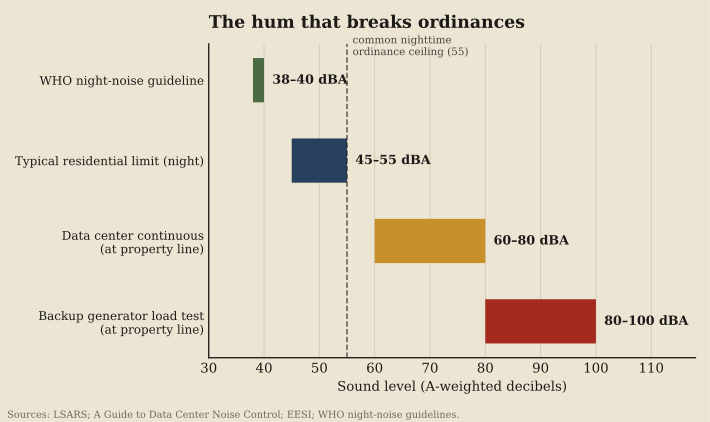
Continuous — cooling fans and evaporative towers, transformers and electrical switchgear, and HVAC ventilation. This is the 24/7 baseline, typically 60–80 dBA at the property line — comparable to a busy street, running all night.
Intermittent — backup generators on monthly load tests and during actual outages, plus service traffic. Generator testing produces 80–100 dBA at the property line, comparable to a leaf blower or motorcycle; some sources report peaks above 105 dB (LSARS; LegalMatch).
For context, residential noise ordinances commonly cap nighttime sound at 45–55 dBA at the property boundary, and the World Health Organization's night-noise guideline is around 40 dBA. A facility running at 60–80 dBA continuously sits well above the ceiling its neighbors are legally entitled to.
The enforcement gap that sinks weak ordinances
Here is the trap most communities fall into: they pass a simple dBA limit, the developer's model shows technical compliance, and residents are miserable anyway. Two reasons:
Tonality and low frequency. Data center noise is tonal — a steady hum concentrated in low-frequency bands. The human brain cannot filter tonal noise the way it filters broadband background sound, so it causes disproportionate annoyance and physiological stress even at decibel levels within the limit (Windham Law; INVC). And low-frequency sound is notoriously hard to capture with a standard A-weighted meter, which makes a plain dBA ordinance difficult to enforce for the very noise residents actually hear (EESI, quoting the National Parks Conservation Association).
Modeling games. Compliance is predicted with software (CadnaA, SoundPLAN) under the ISO 9613-2 standard. The fight is rarely the software — it's the assumptions: which receptors, what weather, whether generator load tests are modeled, and whether the baseline ambient was measured honestly (Ramboll).
The fix is well established and cheap: require a tonal/low-frequency analysis and apply a 6 dBA penalty to the limit unless the developer proves the noise is not tonal — an approach simple enough that adequate tonal analysis runs on a free smartphone app (INVC). This single provision (Demand 2) does more than any number alone.
Health, and the courts
A February 2026 study in Frontiers in Climate found short-term data center noise causes sleep disturbance and annoyance, with long-term exposure associated with cardiovascular, cognitive, and mental-health effects (via Windham Law). Residents report headaches, vertigo, nausea, ear pain, and hypertension (EESI). The litigation is following: residents sued the Hyperscale facility in Dowagiac, Michigan over "unreasonable, excessive noise" measured at 60–70 dBA (WWMT, 2026); a nuisance suit was filed against a Colleton County, South Carolina facility in January 2026 (Duquesne JOULE). Courts can order quieter equipment, sound barriers, or restricted operating hours — but a nuisance suit after the fact is a poor substitute for an enforceable condition before approval.
4.2 Air: backup generators and the gas-turbine loophole
The two air-quality threats
Backup diesel generators. A hyperscale campus may permit dozens to hundreds of diesel generators for outage protection. They are tested regularly (a noise source, §4.1) and run during grid failures, emitting NOx, particulate matter, and air toxics. Each is a regulated stationary source — or should be.
Behind-the-meter gas generation. As grid interconnection queues lengthen (Part 2), developers increasingly build their own on-site power — gas turbines — to bypass the grid. This converts a "data center" into a de facto power plant next to homes, and it is the fastest-growing air-quality threat in the sector. The defining abuse is the "nonroad engine" loophole: classifying large stationary turbines as "temporary" or "nonroad" engines to claim they are exempt from Clean Air Act permitting, public notice, and best-available pollution controls (Tennessee Lookout; SELC). That loophole is exactly how 35 turbines ran unpermitted in Memphis — the subject of §4.3.
This is the air-quality counterpart to Part 2's Demand 12 (behind-the-meter generation rules). The energy chapter cares that on-site gas evades tariff obligations; this chapter cares that it poisons the air your neighbors breathe. Both demands must be made together, because developers present on-site generation as a solution (faster power, grid relief) precisely to slip past the harm.
4.3 The Memphis file: xAI's Colossus
One case study, because it is the clearest illustration in the country of how the quality-of-life and environmental-justice failures compound.
Elon Musk's xAI began operating its Colossus 1 supercomputer in South Memphis in June 2024, using as many as 35 gas turbines with no permits at all (SELC, April 2026). The site sits in the 38109 zip code, beside the majority-Black neighborhood of Boxtown — a community already carrying an oil refinery, a steel mill, and a TVA gas plant, where studies put the cancer risk at four times the national average (NAACP, June 2025).
The sequence every community should study:
- The loophole. Rather than permit the turbines as the major pollution source they plainly are, the Shelby County Health Department accepted that they were "temporary," "nonroad" engines — exempt from permitting, public notice, and pollution controls (Tennessee Lookout, July 2025). The appeal by the NAACP's Memphis chapter and Young, Gifted & Green argued this reading would let any operator install any number of polluting turbines, anywhere, anytime, with no public process.
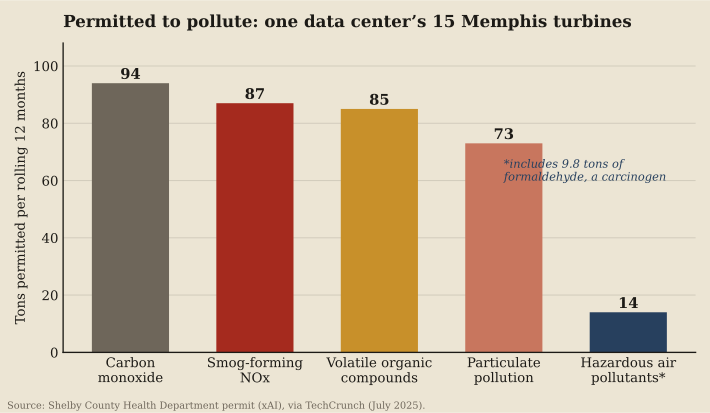
- The permit that legalized the pollution. In July 2025 the county issued a permit for 15 turbines — while xAI had already been running far more without one. The permit allows annual emissions of 87 tons of NOx, 94 of carbon monoxide, 85 of VOCs, 73 of particulates, and ~14 tons of hazardous air pollutants including 9.8 tons of formaldehyde — and lets the company keep its own emissions records (TechCrunch, July 2025).
- The contested "all clear." City-commissioned testing reported no dangerous pollutant levels; SELC noted the testing did not even measure ozone — the pollutant Memphis already fails federal standards for (Tennessee Lookout; CNBC). Independent University of Tennessee research found the turbines added measurably to the region's pollution (CNBC, Jan 2026).
- The escalation. xAI then built a second turbine fleet in Southaven, Mississippi to power Colossus 2 — 27 turbines, expanded to add six more, again challenged as unpermitted — prompting the NAACP, SELC, and Earthjustice to seek a preliminary injunction in 2026 (Earthjustice).
The lessons map directly onto the demands: the loophole must be closed by contract and permit (Demand 4); emissions must be independently monitored, not self-reported (Demand 6); air studies must measure the right pollutants and be community-controlled (Demand 6); cumulative burden on an already-overloaded airshed must be assessed before approval (Demand 7); and none of it works without enforceable standing for the people of Boxtown (Demand 13). Memphis is what happens when a community gets none of these. The point of this handbook is to get all of them — in writing, before the turbines arrive.
4.4 Light, massing, setbacks, traffic — the rest of the footprint
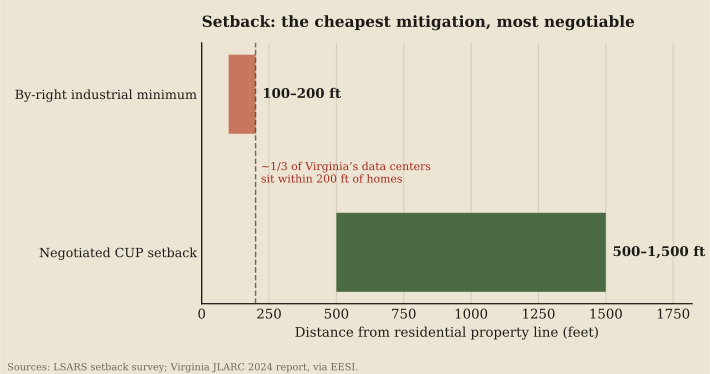
Setbacks are the cheapest, most reliable mitigation in this entire chapter: sound and light dissipate with distance more predictably than any engineering control can promise, and distance costs the developer land, not technology. Yet by-right industrial zoning often requires only 100–200 feet from a residential line, while negotiated conditional-use setbacks run 500–1,500 feet (LSARS). The gap between those numbers is pure negotiating space — and the stakes are concrete: Virginia's 2024 JLARC review found nearly one-third of the state's data centers sit within 200 feet of residentially zoned land, a consequence of zoning codes that file data centers alongside offices rather than heavy industry (EESI).
Light pollution. Campus and security lighting runs all night, often beside rural or residential areas with previously dark skies. Shielded, downcast, motion-activated, warm-temperature fixtures are standard dark-sky practice and trivial to require.
Massing and viewshed. A hyperscale building is a windowless box that can exceed 60 feet in height and cover hundreds of thousands of square feet. Height caps, architectural treatment, generous vegetative buffers, and preservation of existing tree lines are ordinary land-use conditions — they simply have to be demanded.
Construction. The Newton County water damage (Part 3) began during construction, not operation. Multi-year buildouts bring blasting, dewatering, dust, heavy truck traffic, and noise. Residents near one proposed Georgia site face an estimated decade of construction along a creek corridor (Windham Law). A construction-management plan — hours, haul routes, dust control, blasting limits and monitoring — belongs in the agreement.
Property values. Homeowners beside an industrial neighbor with 24-hour noise and light face real value loss. Some jurisdictions negotiate property-value protection (assessment guarantees or buy-out options for the nearest parcels), the way airport-noise programs do.
4.5 Environmental justice and cumulative impact
The Memphis pattern is not an accident; it is the model. Heavy industrial uses are sited where opposition is expected to be weakest — lower-income and minority communities already carrying legacy pollution. The structural defenses are two:
Cumulative-impact assessment. Agencies and developers assess each facility's emissions in isolation, as if the refinery, the steel mill, and the gas plant next door did not exist. A community should demand that noise, air, and traffic impacts be evaluated additively, against the total existing burden of the airshed and the neighborhood — and that an environmental-justice screen (using EPA EJScreen or a state equivalent) be part of the application.
Equity in siting and benefit. Where a facility is proposed in an already-overburdened community, the burden of proof should shift to the developer to show it will not worsen existing disparities — and the community-benefit terms (later chapters) should be commensurate with the elevated risk being asked of the residents. The NAACP's 2026 community-benefits framework is built precisely around this principle.
4.6 The demands: what to ask for, and why
Same format: the ask, the justification, the benchmark.
Demand 1 — Independent baseline + predictive noise study, before approval
The ask: A developer-funded, community-selected acoustician (a) measures baseline ambient noise at the site day and night, and (b) models predicted operational noise at every sensitive receptor within one mile — under both continuous operation and generator load-test scenarios — using ISO 9613-2, with explicit identification of where the local nighttime limit would be exceeded.
Justification: A noise objection survives a hearing only with specific data; vague worry does not (LSARS). Without a pre-approval baseline you can never prove the facility caused the change — the Newton County water lesson (Part 3) applied to sound. Modeling that omits generator load tests or sensitive receptors is the most common way real impacts get approved on paper.
Benchmark: LSARS's defensible-review standard (baseline day/night + receptor modeling + exceedance analysis) is the template; ISO 9613-2 (updated 2024) is the accepted North American model.
Demand 2 — A real nighttime limit with a tonal penalty and teeth
The ask: A binding limit at the nearest residential property line — 45–55 dBA at night — plus a 6 dBA penalty applied unless the developer proves via narrowband analysis that the noise is not tonal; continuous, public, independent monitoring; and escalating per-violation liquidated damages with curtailment as the final remedy.
Justification: A plain dBA cap fails because the harm is tonal and low-frequency — disproportionately annoying and physiologically stressful even "within limits," and hard to capture on an A-weighted meter (INVC; EESI; Windham Law). The tonal penalty shifts the burden onto the developer to design quietly, which is cheapest at the design stage anyway (Ramboll).
Benchmark: The INVC 6 dBA tonal-penalty approach; municipal nighttime caps of 45–55 dBA; Dowagiac and Marshall, Michigan rewriting ordinances specifically for this.
Demand 3 — Engineering controls and equipment selection as conditions
The ask: Require low-noise coolers, acoustic enclosures and barriers, and equipment chosen for minimal tonal/low-frequency emission — specified in the conditional-use permit, not left to good intentions.
Justification: None of these are typically included voluntarily; they appear when councils require them as CUP conditions (LSARS). Addressing tonality through equipment selection at design time is the most cost-effective path and avoids the multi-million-dollar retrofits that follow community complaints (Ramboll; INVC).
Benchmark: Low-noise industrial coolers are commercially standard (EESI); "quiet places" zoning that prohibits loud uses near homes is an established tool.
Demand 4 — Close the "nonroad/temporary" loophole: permit all generation as stationary sources
The ask: Every on-site generator and turbine — backup or primary — is treated as a stationary source subject to full Clean Air Act permitting, public notice, and Best Available Control Technology. No "temporary" or "nonroad engine" classification. Behind-the-meter gas generation as primary power is prohibited or separately permitted as the power plant it is.
Justification: The nonroad-engine loophole is the single largest air-quality abuse in the sector — it is exactly how 35 turbines ran unpermitted in Memphis, and the legal theory that, unchallenged, would let any operator install unlimited turbines with no public process (Tennessee Lookout; SELC). BACT and public notice are the entire point of the permitting system.
Benchmark: The NAACP/SELC/Earthjustice Clean Air Act actions against xAI; the EPA rule update tightening turbine treatment (CNBC, Jan 2026); Maryland HB 120's co-location/generation conditions (Part 2).
Demand 5 — Generator caps, run-hour limits, daytime-only testing, Tier 4 emissions
The ask: Contractual caps on generator count and aggregate capacity; annual run-hour limits; testing confined to defined daytime windows; and Tier 4 (or best-available) emissions standards on all diesel units.
Justification: Generator fleets are both an air source (run hours = emissions) and a noise source (load tests = 80–100 dBA). Confining tests to daytime and capping run hours directly limits both. Self-reported, uncapped emissions — as in the Memphis permit, which lets the operator keep its own records — are unverifiable by design (TechCrunch).
Benchmark: Tier 4 standards are routine for new stationary diesel; daytime-only test windows are common nuisance-ordinance practice.
Demand 6 — Independent, continuous, public air monitoring + community study funding
The ask: Fenceline air monitoring (continuous, third-party, publicly reported) for NOx, PM2.5, ozone precursors, VOCs, and formaldehyde; plus developer funding for an independent community air-quality study — scoped and controlled by the community, measuring the right pollutants.
Justification: Self-reported emissions are not oversight. The Memphis "all-clear" testing failed to measure ozone — the one pollutant the region already violates — which is why independent University of Tennessee research, not the official test, surfaced the real impact (CNBC; Tennessee Lookout). A Memphis community group had raised $250,000 for its own study precisely because it could not trust the official one; build that funding into the agreement so residents don't have to crowdfund their own air data.
Benchmark: Fenceline monitoring is standard at refineries and chemical plants; the $250,000 community-study figure from Memphis is a real-world benchmark for adequate independent testing.
Demand 7 — Cumulative-impact and environmental-justice assessment
The ask: Noise, air, and traffic impacts assessed additively against the total existing burden of the airshed and neighborhood — not in isolation — with an EPA EJScreen (or state-equivalent) environmental-justice analysis required as part of the application, and a burden-shift to the developer in already-overburdened communities.
Justification: Isolated, per-facility review is how concentrated harm becomes invisible: Boxtown already hosts a refinery, a steel mill, and a gas plant, and each new source is waved through as if alone (NAACP; SELC). Cumulative assessment is the only honest way to evaluate a marginal addition to a saturated airshed.
Benchmark: EPA EJScreen; New Jersey's environmental-justice law (cumulative-impact permitting in overburdened communities) is the leading statutory model.
Demand 8 — Setbacks and buffers sized to the modeling
The ask: Minimum setbacks of 500–1,500 feet from residential property lines (scaled to the Demand 1 noise modeling so the nighttime limit is met at the nearest home), with vegetative and berm buffers maintained for the life of the facility.
Justification: Distance is the cheapest, most reliable mitigation and the most negotiable term in the chapter (LSARS). By-right zoning's 100–200 feet is an artifact of miscategorizing data centers as offices — the Virginia JLARC finding that a third sit within 200 feet of homes is the cautionary statistic.
Benchmark: Negotiated CUP setbacks of 500–1,500 feet (LSARS); reclassifying data centers as the heavy-industrial use they are.
Demand 9 — Dark-sky lighting standards
The ask: Shielded, downcast, motion-activated, warm-color-temperature lighting; no uplight; limits on after-hours illumination beyond security minimums.
Justification: All-night campus lighting degrades rural and residential night skies and compounds the sense of an industrial intrusion. Dark-sky standards are well-defined, inexpensive, and routinely adopted.
Benchmark: International Dark-Sky Association model ordinance language.
Demand 10 — Massing, height, and viewshed treatment
The ask: Height caps, architectural treatment of long blank façades, deep perimeter landscaping, and preservation of existing tree lines and natural screening — with maintenance obligations that run with the facility.
Justification: A windowless 60-foot box across hundreds of thousands of square feet is a permanent visual imposition on neighbors and rural character; screening and massing controls are ordinary land-use conditions that cost the developer little and protect property and place.
Benchmark: Standard industrial-design and buffer conditions in conditional-use permitting.
Demand 11 — A binding construction-management plan
The ask: Enforceable limits on construction hours; haul-route and traffic-management plans; dust and stormwater controls; and blasting and dewatering limits with seismic and well monitoring (coordinated with Part 3, Demands 6–8).
Justification: The worst damage often arrives during the multi-year build, before any operational condition applies — Newton County's wells failed during construction. Communities face a decade of construction traffic, noise, and dust where buildouts are phased (Windham Law).
Benchmark: Construction-management plans are standard for large projects; the demand is simply that they be enforceable conditions tied to penalties.
Demand 12 — Property-value protection for the nearest neighbors
The ask: For homes within a defined radius, an assessment guarantee or buy-out option funded by the developer, compensating measurable value loss attributable to the facility.
Justification: The residents who bear the noise, light, and traffic should not also silently absorb the property-value loss while the facility becomes the county's largest taxpayer. The mechanism is borrowed from airport-noise programs, where it is well established.
Benchmark: Airport noise-mitigation buy-out and sound-insulation programs.
Demand 13 — Standing, enforcement, and an advisory board with teeth
The ask: (a) Residents named as third-party beneficiaries with a preserved right to sue — explicitly not waived; (b) a community advisory board meeting at least quarterly with independent technical experts at developer expense; (c) annual public compliance reporting against every condition in this chapter; (d) a remedy ladder ending in curtailment or suspension for persistent violation.
Justification: This is Part 1's enforcement rule, sharpened by this chapter's stakes. Lancaster's CBA was faulted for limiting residents' ability to sue over noise — the exact opposite of what's needed (Part 1). Nuisance suits in Dowagiac and Colleton County show residents will litigate; an advisory board and preserved standing convert that energy into ongoing oversight rather than years of after-the-fact court fights.
Benchmark: The NAACP CBA template's quarterly advisory board and independent-expert provisions; the preserved private right of action that weak CBAs strip out.
4.7 Where each fight happens
| Venue | What's decided there | Your tools |
|---|---|---|
| City / county board (zoning, CUP) | Setbacks, noise limits, lighting, massing, construction rules, advisory board | Demands 1–3, 8–13 as conditions of approval |
| Air pollution control board / health dept. | Generator and turbine permits, BACT, the nonroad loophole | Demands 4–6; appeal permits (the Memphis model) |
| State environmental agency / EPA | Major-source determinations, EJ review, ozone attainment | Demands 4, 6, 7; comment and appeal |
| Noise authority / code enforcement | Ordinance limits, monitoring, violations | Demand 2; rewrite the ordinance before the application |
| Courts | Nuisance, Clean Air Act citizen suits | Demand 13; the Dowagiac, Colleton, and Memphis suits |
| State legislature | EJ cumulative-impact law, noise/siting standards | Support NJ-style EJ permitting; reclassify data centers as industrial |
Sequencing: rewrite the noise and lighting ordinances and reclassify data centers out of the office category before an application lands — afterward you are litigating, not legislating. Air permits are appealable, but the public-process leverage is greatest before issuance.
4.8 The asks at a glance
| # | Demand | Benchmark | Primary venue |
|---|---|---|---|
| 1 | Independent baseline + predictive noise study | LSARS standard; ISO 9613-2 | CUP condition |
| 2 | Nighttime dBA limit + 6 dBA tonal penalty + monitoring | INVC; 45–55 dBA municipal caps | Noise ordinance + CUP |
| 3 | Engineering controls / quiet equipment | Low-noise coolers (EESI) | CUP condition |
| 4 | Permit all generation; close nonroad loophole | xAI CAA actions; EPA rule update | Air board + agreement |
| 5 | Generator caps, run-hours, daytime tests, Tier 4 | Standard stationary-diesel rules | Air permit + CUP |
| 6 | Independent fenceline monitoring + study funding | Refinery fenceline norms; $250k Memphis study | Air board + agreement |
| 7 | Cumulative-impact + EJ assessment | EPA EJScreen; NJ EJ law | State agency + board |
| 8 | Setbacks 500–1,500 ft, sized to modeling | LSARS; VA JLARC cautionary stat | CUP condition |
| 9 | Dark-sky lighting | IDA model ordinance | CUP condition |
| 10 | Massing, height, viewshed treatment | Standard industrial buffers | CUP condition |
| 11 | Construction-management plan | Standard large-project practice | CUP condition |
| 12 | Property-value protection | Airport noise buy-out programs | Agreement |
| 13 | Standing + advisory board + curtailment remedy | NAACP template; anti-Lancaster | Agreement |
4.9 References
Noise
- EESI, "Communities Are Raising Noise Pollution Concerns About Data Centers," March 2026 (PW County >60 dB; VA JLARC ~1/3 within 200 ft; health effects; NPCA on low-frequency measurement). https://www.eesi.org/articles/view/communities-are-raising-noise-pollution-concernsabout-data-centers
- LSARS, "Data Center Noise: How Loud, How Far, How to Address" (60–80 dBA continuous; 80–100 dBA load tests; setback ranges; defensible-review standard). https://www.lsars.com/data-center-noise
- Industrial Noise & Vibration Centre, "Data Center Noise Regulation: a smarter approach" (6 dBA tonal penalty; smartphone tonal analysis). https://invc.com/noise-assessment/data-center-noise-regulation-ordinances/
- Ramboll, "Data centers challenge communities: revising noise ordinances for balance" (tonality, ISO 9613-2, design-stage controls). https://www.ramboll.com/en-us/data-centers-challenge-communities-revising-noise-ordinances-for-balance
- Windham Law, "Data Center Nuisance Lawyer" (Frontiers in Climate Feb 2026 health study; resident-reported impacts; decade-of-construction case). https://windhamlaw.com/practice-areas/data-center-nuisance-lawyer/
- A Guide to Data Center Noise Control, NoiseMonitoringServices (45–55 dBA boundary norms; PW County advisory group). https://noisemonitoringservices.com/data-center-noise-control/
- WWMT, "Residents suing Hyperscale data center in Dowagiac over noise," 2026, and "City of Marshall evaluating noise ordinances," May 2026. https://wwmt.com/news/local/lawsuit-hyperscale-data-center-dowagiac-noise-class-action-business-center-legal-osha-decibels-contained-digital-asset-mining-facility-rural-southwest-michigan-infrastructure
- Duquesne Law JOULE, "When the Hum Never Stops" (Colleton County, SC nuisance suit). https://sites.law.duq.edu/joule/when-the-hum-never-stops-noise-pollution-data-centers-and-the-limits-of-nuisance-law/
- LegalMatch, "How Does AI Data Center Cause Noise Pollution" (peaks above 105 dB; injunctive remedies). https://www.legalmatch.com/law-library/article/ai-data-center-noise-pollution-lawsuits.html
Air quality and the Memphis case
- NAACP, "Elon Musk's xAI threatened with lawsuit over air pollution from Memphis data center," June 2025 (Boxtown cancer risk 4x; turbines without permits). https://naacp.org/articles/elon-musks-xai-threatened-lawsuit-over-air-pollution-memphis-data-center-filed-behalf
- TechCrunch, "xAI gets permits for 15 natural gas generators at Memphis data center," July 2025 (35 unpermitted; permit emissions tonnages; self-reporting). https://techcrunch.com/2025/07/03/xai-gets-permits-for-15-natural-gas-generators-at-memphis-data-center
- Tennessee Lookout, "NAACP, others appeal xAI turbine permits," July 2025 (nonroad-engine loophole; flawed testing). https://tennesseelookout.com/briefs/naacp-others-appeal-xai-turbine-permits-for-memphis-data-center/
- Southern Environmental Law Center, "xAI built an illegal power plant to power its data center," April 2026 (Colossus 1 = 35 turbines; Southaven). https://www.selc.org/news/xai-built-an-illegal-power-plant-to-power-its-data-center/
- Earthjustice, "NAACP Asks Court for Emergency Action to Stop Illegal Air Pollution from xAI's Data Center Power Plant," 2026 (Southaven 27→33 turbines; injunction). https://earthjustice.org/press/2026/naacp-asks-court-for-emergency-action-to-stop-illegal-air-pollution-from-xais-data-center-power-plant
- CNBC, "Elon Musk's xAI faces tougher road building out data centers after EPA rule update," Jan 2026 (UT Knoxville research; ozone nonattainment; EPA update). https://www.cnbc.com/2026/01/16/musks-xai-faces-tougher-road-expanding-memphis-area-after-epa-update.html
Setbacks, EJ, and siting
- Virginia JLARC, 2024 data center report (siting within 200 ft of residential), via EESI (above).
- EPA EJScreen environmental-justice screening tool. https://www.epa.gov/ejscreen
- New Jersey Department of Environmental Protection, Environmental Justice Law (cumulative-impact permitting in overburdened communities). https://dep.nj.gov/ej/law/
Decibel ranges, ordinance limits, and permit terms vary by facility design and jurisdiction. Verify your local noise ordinance, your airshed's attainment status, and your state's EJ law before testimony.