
Part 5: Fiscal Terms
A hyperscale campus can become a county's largest single taxpayer — and it can also be the worst subsidy deal that county ever signs. Both are routinely true of the same project. This chapter is about telling them apart: how to measure what a data center actually nets your community after the abatements and infrastructure costs, and the twelve demands that keep the revenue real and the giveaways out.
5.0 Both things are true
The fiscal debate is usually conducted as a shouting match between two half-truths. Boosters say data centers are economic gold — among the largest taxpayers a rural county will ever host. Critics say they're subsidy sinkholes that buy almost nothing. The honest answer is that both describe real deals, and which one your community gets depends entirely on the terms.
The revenue is real: a hyperscale campus pays property tax on land, buildings, and — where it's taxed — computer equipment that is replaced every few years, renewing the base. West Des Moines's agreements with Microsoft are projected to generate over $2 billion in tax revenue (Brookings, Jan 2026).
The giveaways are also real, and have grown indefensible. Virginia's data center sales-tax exemption alone cost an estimated $1.6 billion in fiscal year 2025 — now the state's single largest incentive (Cardinal News). And the structure of these deals means a community can sign away most of the revenue while keeping all of the impact.
The 2026 reckoning is well underway. At least 37 states offer data center incentives (NCSL), but the states that competed hardest — Virginia, Georgia, Oklahoma, Indiana, Ohio, Illinois — are now reconsidering, capping, or clawing back their programs (Stateline; Brookings; Policy Matters Ohio). Your community is negotiating at the exact moment the consensus is shifting from "give whatever it takes" to "prove it's worth it." This chapter arms you to demand the proof.
5.1 The incentive landscape
Three instruments do most of the work, usually stacked:
Sales-and-use tax exemptions — the most common incentive, waiving sales tax on the servers, networking gear, and electrical equipment that make up most of a facility's cost (Stateline). Because that equipment is replaced every few years, the exemption renews indefinitely — Amazon's Ohio agreement, for instance, runs through 2055 (Policy Matters Ohio).
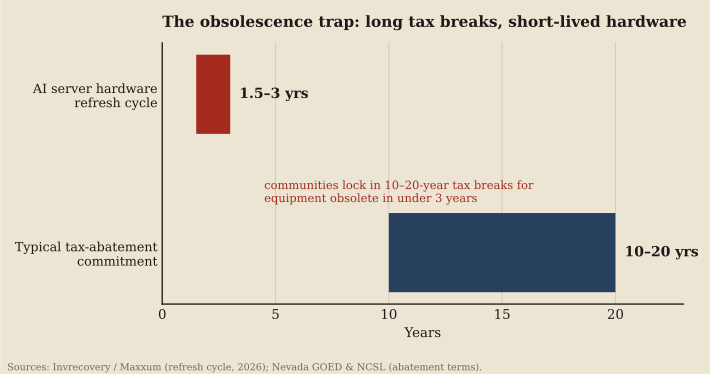
Property-tax abatements — partial or full forgiveness of property tax on land, buildings, and sometimes equipment, for a fixed term. Nevada's statute, a typical example, abates 75% of personal-property tax for 10–20 years and cuts the sales-tax rate to 2%, in exchange for job, wage, and investment thresholds (Nevada GOED).
Payments in lieu of taxes (PILOTs) — a negotiated alternative to property tax, where the facility makes fixed annual payments instead. A PILOT can be a good tool (it can guarantee revenue to schools and municipalities) or a giveaway dressed up as a payment — the difference is in the number (see §5.5).
The critical structural facts for your negotiation: these incentives are usually stacked (state sales-tax exemption plus local property abatement plus sometimes discounted power), they often lack clawbacks, and the details are frequently hidden behind NDAs and trade-secret claims (Part 4's secrecy problem, applied to money). Good Jobs First's model reforms target exactly this: requiring a public MOU with clawbacks, notifying affected municipalities, conditioning state exemptions on local approval, and prohibiting incentive stacking — Georgia's law already bars companies claiming the sales-tax exemption from also taking other incentives.
5.2 The cost-per-job problem
Because data centers are among the least labor-intensive structures in the economy (Part 1: typically 10–30 permanent jobs), incentives measured per job reach figures that would be laughed out of any other economic-development meeting:
- Ohio: 13 approved agreements covering $5.1 billion in investment generated just 356 jobs — a state revenue loss of $281.9 million, or $343 million with local sales tax included: nearly $1 million per job (Policy Matters Ohio). Amazon's exemption, against $13.87 billion in investment, also pencils out to well over $1 million per job.
- Rockland County, New York: a JPMorgan data center received roughly $77 million in tax breaks while reporting 25 workers (up from the 5 originally promised) — well over $1 million per job, with an expansion deal "in another league" (NY Focus, April 2026).
- STAMP, New York: the proposed $11.2 billion Stream Data project carries a subsidy package that works out to $6.4 million per job — ranked by Good Jobs First among the largest data center subsidy packages ever proposed in the United States (Investigative Post, Feb 2026).
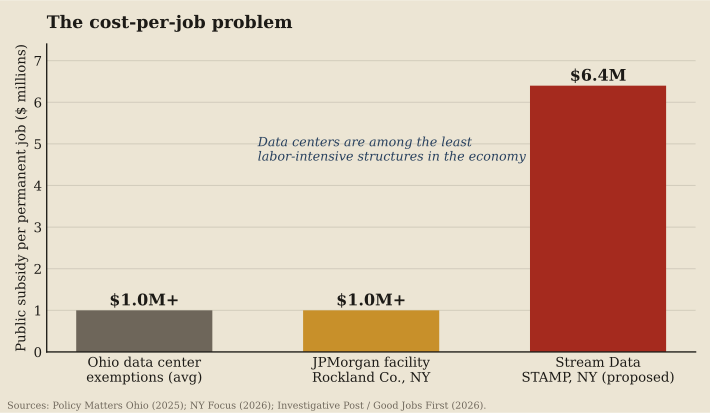
The negotiating implication is not "jobs don't matter" — it's that jobs are the wrong metric to price an incentive on. A deal justified by employment is a deal justified by the weakest thing a data center produces. Tie any incentive to verified investment and operating years, not headcount (Demand 3), and measure the whole deal by net fiscal benefit, not job count (Demand 1).
5.3 The deal you don't have to give
Here is the single most valuable fact in this chapter: for the largest facilities, the incentive is rarely what decides the deal. Brookings's 2026 study found that in hyperscale counties, public incentives amount to only about 2% of total construction investment — and hyperscale siting is driven by power availability, land, and fiber, not tax breaks. In colocation counties, by contrast, incentives represent about 62% of total investment — meaning your community's money is decisive precisely for the facilities that deliver the fewest jobs and the least economic spillover (Part 1).
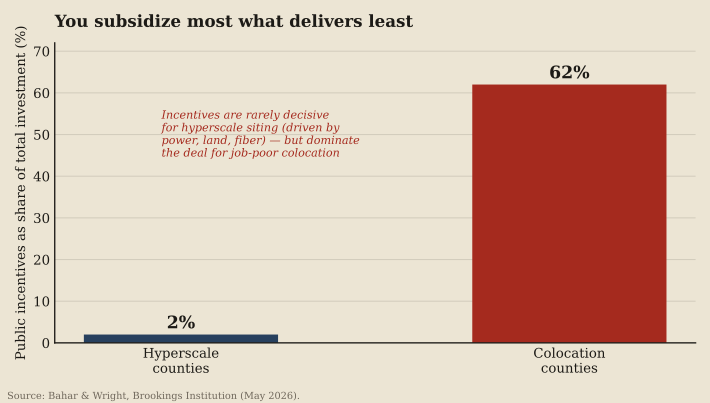
Read those two numbers together and a strategy emerges:
- When a hyperscale developer says it will walk without the abatement, that is usually a bluff — they're choosing your site for the power and fiber, and a 2% incentive is not the swing factor. You can negotiate hard, or decline to abate, and still get the project.
- When a colocation developer makes the same threat, it may be true — but per Brookings that's the facility least worth subsidizing, so it's the deal you can most afford to lose.
Either way, the "we'll go elsewhere" threat (Part 1's developer playbook) loses its power once you know which side of this chart your project sits on. Always establish facility type before discussing a single dollar of incentive.
5.4 Phantom revenue and the obsolescence trap
Revenue projections presented at the approval hearing are best-case, full-buildout, full-operation numbers. Several forces erode them:
The phasing gap. Projections assume the whole campus gets built; many projects build a fraction of what they entitle (Part 1, §1.1). Revenue scoped to full buildout is revenue you may never see.
Equipment obsolescence. AI hardware refresh cycles have compressed to roughly 18–36 months (Invrecovery; Maxxum) — yet tax abatements commonly run 10–20 years. A community can lock in a two-decade tax holiday for equipment that's scrap before the third year. If the value of the equipment (the renewing tax base) is abated, the renewal benefit evaporates.
Stranding. Facilities that can't secure additional power or that fall behind the hardware curve are increasingly abandoned as operators consolidate into newer campuses (Maxxum, April 2026). A stranded data center is a specialized, hard-to-repurpose shell — and if the operator was a single-purpose LLC that dissolves, the community inherits the end-of-life problem (Taft Law). This is the fiscal cousin of Part 2's energy stranded-asset risk, and it is why Demand 8 (decommissioning security) exists.
The honest counterpoint, which a credible handbook should state: a "powered shell" with strong floor loading and utility connections can sometimes be converted to logistics or light industrial use, so the stranding risk is real but not absolute (Taft Law). That nuance is an argument for right-sizing the decommissioning bond to realistic net removal cost — not for skipping it.
5.5 PILOTs: the same tool, used well or badly
A PILOT is neither good nor bad in itself; it's a container for a number. The Stream Data STAMP proposal shows a relatively strong structure: a 30-year PILOT under which the company pays its full property-tax-equivalent plus more — averaging $9.5 million annually, with no reduction to county, municipal, or school revenue, on top of an estimated $18 million in annual sales tax on electricity (Investigative Post). Whatever one thinks of the per-job math, the property-tax side of that deal protects schools.
A bad PILOT does the opposite: it sets payments far below what full taxation would yield, freezes them flat for decades (so inflation erodes them), and is sold to the public as "new revenue" because the land previously generated little. The tests of a good PILOT:
- Payments at least equal to, and ideally above, what full property taxation would yield;
- Escalation clauses so the payment grows with inflation and assessed value;
- A guaranteed floor to schools and emergency services (the entities that bear the service costs);
- No bundling that quietly waives the sales-tax base on top.
If a developer proposes a PILOT, the right response is not yes or no — it's "show me the number against full taxation, escalated, over the full term," and Demand 1's independent fiscal study to check their math.
5.6 The demands: what to ask for, and why
Same format: the ask, the justification, the benchmark.
Demand 1 — An independent net-fiscal study, developer-funded, community-controlled
The ask: Before any vote, an independent analyst (selected by the community, paid by the developer) produces a full net-fiscal model: gross tax revenue minus every abatement and exemption, minus the public cost of infrastructure (roads, water, fire/EMS capacity for electrical and battery fires), minus any ratepayer cost-shift (Part 2), at realistic — not full-buildout — assumptions, over the full term.
Justification: Every fiscal claim at the hearing comes from a study the developer commissioned to its own specifications. A net figure — revenue after costs — is the only number that answers the only question that matters: does this make the community better or worse off? Boosters cite gross revenue; the gap between gross and net is where the giveaway hides.
Benchmark: Good Jobs First and Brookings both call for independent net analysis; the NAACP CBA template requires developer-funded independent studies controlled by the community.
Demand 2 — No blank-check abatement; scale any incentive to verified net benefit
The ask: Default to full taxation. Grant abatements only where the Demand 1 study shows a positive net benefit, capped at the minimum needed, with a defined dollar ceiling and a per-job and per-dollar-of-net-benefit disclosure attached to the public vote.
Justification: The cost-per-job figures (§5.2) are what happens when incentives are granted by reflex rather than analysis. Brookings's 2% finding (§5.3) shows most hyperscale abatements aren't even decisive. Good Jobs First's first-listed reform is the bluntest: eliminate data center tax abatements entirely. Short of that, every dollar abated should be a dollar the study proves is necessary.
Benchmark: Good Jobs First model reforms (2025); the Virginia/Georgia/Ohio rollbacks now underway; Georgia's anti-stacking statute.
Demand 3 — Performance-based clawbacks, tied to investment and operating years
The ask: Every incentive is contingent on verified milestones — capital invested, facility operating, years in service — with automatic, retroactive recoupment of abated taxes if the project underdelivers, downsizes, or leaves early. Tie clawbacks to investment and longevity, not headcount.
Justification: Incentives are awarded on promises; clawbacks are what make the promises real. States already do this — Nevada cancels and recoups when thresholds aren't met (Nevada GOED). The JPMorgan facility that promised 5 jobs and the data center that delivered a fraction of projections (§5.2) are why "trust us" is not a term. Tie to jobs and you reward the weakest metric; tie to investment and operating years and you protect the tax base that actually matters.
Benchmark: Nevada's statutory clawback; Good Jobs First's required clawback provisions in every recipient MOU.
Demand 4 — No incentive stacking; condition state breaks on local consent
The ask: Prohibit a facility from combining the state sales-tax exemption with local property abatements, utility rate preferences, and other credits; and condition any state exemption on approval by every affected local government.
Justification: Stacking is how the headline incentive multiplies into the real giveaway, and how state officials end up handing away local revenue the locality never voted on (NY Focus quotes a reform advocate: giving local IDAs power over state sales tax "doesn't make a lot of sense"). Conditioning state breaks on local consent puts the decision where the impact lands.
Benchmark: Georgia's law barring exemption-claimers from other incentives; Connecticut's bill requiring municipal notification and local approval (Good Jobs First).
Demand 5 — Tax the equipment; protect the renewing base
The ask: Resist exemptions on computer and electrical equipment. Where equipment is the abated item, ensure the abatement sunsets so the renewing equipment base eventually returns to the rolls.
Justification: Equipment refreshed every 18–36 months is, in principle, a renewing tax base — the genuine fiscal upside of a data center. Exempt it (as the most common incentive does) and you've waived the one revenue stream that regenerates. The obsolescence trap (§5.4) cuts both ways: short hardware life is a liability if you abate the equipment and an asset if you tax it.
Benchmark: The contrast between sales-tax-exemption states (equipment untaxed) and property-tax jurisdictions that assess equipment; Ohio's exemption-through-2055 as the cautionary case.
Demand 6 — Full public disclosure of every incentive
The ask: All incentives, the signed MOU/agreement, and the net-fiscal study posted on a public webpage before the vote; no NDA may conceal the value or terms of public subsidies.
Justification: Subsidies are public money; concealing them behind the NDAs and trade-secret claims documented in Parts 1 and 4 is indefensible when the public is the one paying. Disclosure is also the only way clawbacks and net-benefit caps can be enforced — you can't audit what you can't see.
Benchmark: Good Jobs First's public-posting requirement; the broader anti-NDA principle from Part 1, §1.5.
Demand 7 — A decommissioning bond and end-of-life security
The ask: A financial assurance instrument (surety bond, escrow, or letter of credit) sized to the realistic net cost of equipment removal, demolition or repurposing, and site restoration — with the amount periodically re-estimated, and the obligation surviving any change of ownership.
Justification: AI-driven obsolescence and consolidation are already stranding facilities (§5.4); a single-purpose LLC can dissolve and leave the community holding a specialized, hard-to-reuse shell (Taft Law). Telecom learned this with cell-tower decommissioning bonds, which now must follow the asset through ownership changes (United Casualty). Size the bond to net cost (crediting residual value of a convertible powered shell) so it's defensible, but require it.
Benchmark: Lake County, Indiana's data center decommissioning ordinance; the Chester/Montgomery County, Pennsylvania model ordinance guide (2026), which includes decommissioning and a CBA appendix; established telecom tower-decommissioning bonds.
Demand 8 — Sunset clauses and periodic review on every abatement
The ask: Any abatement carries a firm sunset date and a scheduled public review (e.g., every 5 years) testing actual performance against the projections that justified it, with authority to modify or terminate.
Justification: Open-ended exemptions like Amazon's through-2055 deal commit communities for decades on the basis of forecasts that were never revisited. The whole 2026 reform wave exists because programs granted in the 2010s were never reviewed against results. Build the review in from the start.
Benchmark: The state-level reviews now driving rollbacks in Virginia, Ohio, Georgia, Indiana, and Illinois.
Demand 9 — Full recovery of public-service costs
The ask: The facility funds its marginal demand on public services — road wear from construction and operations, water/sewer capacity (Part 3), and specialized fire/EMS capability for high-voltage electrical and lithium-battery fires — quantified in the Demand 1 study and recovered through fees, the PILOT, or direct contribution.
Justification: Data centers impose unusual emergency-service costs (battery-storage and electrical fires require specialized response) that small jurisdictions rarely budget for. If these costs aren't recovered, they're a hidden subsidy on top of the visible one, paid by every other taxpayer.
Benchmark: Standard municipal cost-of-service analysis; the fire/EMS capability gap documented in rural data center host communities.
Demand 10 — A community benefit contribution commensurate with impact
The ask: Direct payments to a community fund or to schools and services, with governance defined, scaled to the burden the facility imposes — and, in already-overburdened communities (Part 4), commensurate with the elevated risk being accepted.
Justification: Where a facility nets positive, the community that hosts the impact should share the upside through a defined, governed mechanism — not vague "good neighbor" gestures. Meta's $4.5 million to Newton-area schools and nonprofits (Part 3) shows such payments happen; the demand is to make them contractual, governed, and proportional rather than discretionary PR.
Benchmark: West Des Moines/Microsoft revenue structures; the NAACP CBA template's community-fund governance provisions.
Demand 11 — Anti-shell-LLC: parental guarantee on all fiscal obligations
The ask: Where the applicant is a single-purpose entity, a guarantee from the creditworthy ultimate parent backing every fiscal obligation — clawbacks, the decommissioning bond, service-cost recovery, and PILOT payments.
Justification: This is Part 2's collateral principle applied to the fiscal annex. Clawbacks and bonds are worthless against an LLC that can dissolve; the parent guarantee ensures the entity that captured the benefit stands behind the obligations. The same shell structures that conceal water and energy use (Parts 1, 3, 4) also limit fiscal recourse.
Benchmark: Dominion's parental-guarantee option in its energy tariff (Part 2); standard practice in project finance.
Demand 12 — Standing, audit rights, and annual public true-up
The ask: The agreement names residents as third-party beneficiaries; the community has annual audit rights (developer-funded) to verify investment, employment, and payments against commitments; and an annual public true-up reconciles incentives received against benefits delivered, triggering clawbacks where they fall short.
Justification: Part 1's enforcement rule, in fiscal form: an incentive without verification is a gift. Self-reported compliance (the Memphis emissions model, Part 4) is no more trustworthy for tax benefits than for pollution. The annual true-up turns clawbacks from theoretical to automatic.
Benchmark: Good Jobs First's reporting-and-recapture framework; the NAACP template's independent-audit provisions.
5.7 Where each fight happens
| Venue | What's decided there | Your tools |
|---|---|---|
| State legislature | Sales-tax exemptions, statewide programs, clawback law, anti-stacking | Support reform/rollback bills; oppose blank-check exemptions |
| State econ-dev agency / IDA | Exemption approvals, PILOTs, statutory clawbacks | Demands 3, 4, 6; condition approval on local consent |
| County / city board | Property abatements, PILOTs, CBA, decommissioning, service-cost recovery | Demands 1–2, 5, 7–12 as conditions of approval |
| Local assessor / finance | Assessment, equipment taxation, PILOT structure | Demands 5, 9; the net-fiscal model |
| Schools & emergency districts | Revenue floors, service-cost recovery | Demands 9, 10 — get them at the table |
Sequencing: the net-fiscal study (Demand 1) must come before the incentive vote, not after — once an abatement is granted, the leverage to attach clawbacks, bonds, and disclosure is gone. And because incentives are often stacked across state and local venues, coordinate: a local board that grants nothing means little if the state hands over a sales-tax exemption the locality never reviewed.
5.8 The asks at a glance
| # | Demand | Benchmark | Primary venue |
|---|---|---|---|
| 1 | Independent net-fiscal study | Good Jobs First; NAACP template | Board (pre-vote) |
| 2 | No blank-check abatement; scale to net benefit | GJF reforms; 2026 rollbacks | Board + legislature |
| 3 | Performance clawbacks (investment/years) | Nevada statutory clawback | Agency + agreement |
| 4 | No stacking; local consent for state breaks | Georgia anti-stacking; CT bill | Legislature + agency |
| 5 | Tax the equipment; protect renewing base | Property-tax vs exemption states | Assessor + agreement |
| 6 | Full public disclosure of incentives | GJF public-posting | All venues |
| 7 | Decommissioning bond (net cost) | Lake County IN; PA model ordinance | Board condition |
| 8 | Sunset + periodic review | 2026 state program reviews | Board + legislature |
| 9 | Full public-service cost recovery | Cost-of-service analysis | Board + districts |
| 10 | Community benefit commensurate with impact | West Des Moines; NAACP template | Agreement |
| 11 | Parental guarantee on fiscal obligations | Dominion guarantee (Part 2) | Agreement |
| 12 | Standing + audit + annual true-up | GJF recapture framework | Agreement |
5.9 References
Incentive costs and cost-per-job
- Cardinal News, "Tax abatement for data centers is now $1.6 billion a year," Jan 2026. https://cardinalnews.org/2026/01/22/tax-abatement-for-data-centers-is-now-1-6-billion-a-year-is-that-a-giveaway-or-a-bargain/
- Policy Matters Ohio, "Indefensible tax breaks for data centers will cost Ohio," Jan 2025 (13 deals, 356 jobs, ~$1M/job; Amazon through 2055). https://policymattersohio.org/research/indefensible-tax-breaks-for-data-centers-will-cost-ohio/
- NY Focus, "This Data Center Is Getting a $77 Million Tax Break to Create One Job," April 2026 (JPMorgan/Rockland County). https://nysfocus.com/2026/04/20/data-center-tax-break-jpmorgan-chase
- Investigative Post, "Data center wants subsidies of $6.4 million per job," Feb 2026 (Stream Data/STAMP; PILOT structure; Good Jobs First ranking). https://investigativepost.org/2026/02/04/data-center-subsidies-of-6-4-million-per-job/
- Bahar & Wright, Brookings Institution, "New evidence on data center employment effects," May 2026 (incentives 2% hyperscale / 62% colocation). https://www.brookings.edu/articles/new-evidence-on-data-center-employment-effects/
Incentive structure, reform, and PILOTs
- Good Jobs First, "Data Centers: Key Reforms for State Subsidy Legislation," Sept 2025. https://goodjobsfirst.org/data-centers-best-reforms-for-state-subsidy-legislation/
- Stateline, "Data center tax breaks are on the chopping block in some states," Feb 2026. https://stateline.org/2026/02/24/data-center-tax-breaks-are-on-the-chopping-block-in-some-states/
- National Conference of State Legislatures / Data Center Coalition (37–41 states offering incentives), via Stateline and AbitOs. https://abitos.com/tax-incentives-data-centers-2025/
- Nevada Governor's Office of Economic Development, "Data Center 2026" (NRS 360.754 abatement terms and thresholds). https://goed.nv.gov/wp-content/uploads/2025/08/Data-Center-2026.pdf
- Build.inc, "Data Center Tax Incentives 2026" (incentives as conditional cash flow; clawbacks, sunsets, entity requirements). https://build.inc/insights/data-center-tax-incentives-2026
Decommissioning and stranded assets
- Taft Law, "Decommissioning Security for Data Centers... Five Issues Policymakers Should Consider," 2026 (specialized-asset risk; powered-shell convertibility nuance). https://www.taftlaw.com/news-events/law-bulletins/decommissioning-security-for-data-centers-and-other-commercial-development-five-issues-policymakers-should-consider/
- Pennsylvania DEP / Chester & Montgomery County Planning Commissions, "Data Center Ordinance Guide v1.0," April 2026 (decommissioning + CBA appendix). https://files.dep.state.pa.us/PublicParticipation/Citizens%20Advisory%20Council/CACPortalFiles/Meetings/2026_05/2026%20Data%20Center%20Ordinance%20Guide.pdf
- Maxxum USA, "The Coming Wave of Data Center Decommissioning," April 2026 (stranding; consolidation). https://maxxum.com/the-coming-wave-of-data-center-decommissioning/
- Invrecovery, "Data Center Decommissioning in 2026" (18–36 month AI hardware refresh cycle). https://invrecovery.org/data-center-decommissioning-in-2026-navigating-ai-infrastructure-upgrades/
- United Casualty & Surety, "How Tower Decommissioning Bonds Help Manage End-of-Life Infrastructure Risk," April 2026 (bond continuity through ownership change). https://blog.unitedcasualty.com/tower-decommissioning-bonds-managing-risk-in-telecom-infrastructure
- AOL / Post-Tribune, "Lake County Council to vote on data center decommission ordinance," 2026. https://www.aol.com/articles/lake-county-council-vote-data-140000088.html
Incentive statutes, abatement terms, and state reform efforts are changing month to month in 2026. Verify your state's current program and your locality's authority before relying on any figure here.