
Part 8: Process & Organizing
Everything in the first seven chapters is a list of what to ask for. This chapter is about how you get into the room with the power to ask — and the leverage to be answered. The best-drafted demands in the world fail if they arrive after the rezoning vote, from a divided community, with no one funded to negotiate. This is the chapter that makes the other seven usable: how to build the coalition, time the fight, defeat the secrecy, and turn a proposal into a binding agreement — or a denial.
8.0 Process is not the afterthought — it's the whole game
A community can be completely right on the merits and still lose. It can know the water math, the noise thresholds, the cost-per-job figures, and the enforcement architecture cold — and watch a project sail through anyway, because the proposal surfaced two weeks before a vote, the community spoke in scattered individual voices, and the only people in the negotiating room worked for the developer or wanted the deal.
It can also win from a weaker substantive position, because it organized. The evidence is overwhelming and recent: communities have blocked or delayed an estimated $64 billion in data center projects through local organizing; 25 projects were canceled by local opposition in 2025, 21 of them in the second half of the year as groups learned from one another and built regional coalitions; at least 14 states have enacted pauses; and the Data Center Opposition Report documented 268 local opposition groups organizing across the country (Introl; datacenterresponsibility.com). Seattle — a tech-industry capital — moved to a one-year moratorium in June 2026 (Tom's Hardware). The people's playbook, as Food & Water Watch puts it, is winning.
This chapter distills how. Three principles run through it: organize early and broadly, act inside the leverage window, and convert energy into binding terms — never settling for the "vague recommendations shaped by corporations and lobbyists" that the Denver coalition warned a moratorium can become if it isn't pushed into enforceable protections.
8.1 The negotiation arc
Data center fights follow a recognizable sequence, and knowing the stages lets a community see where it is and what comes next. The established CBA process has four phases — public education, community negotiation, contract drafting, and implementation/enforcement (Columbia Climate Law Blog) — which expand, in practice, into a seven-stage arc:
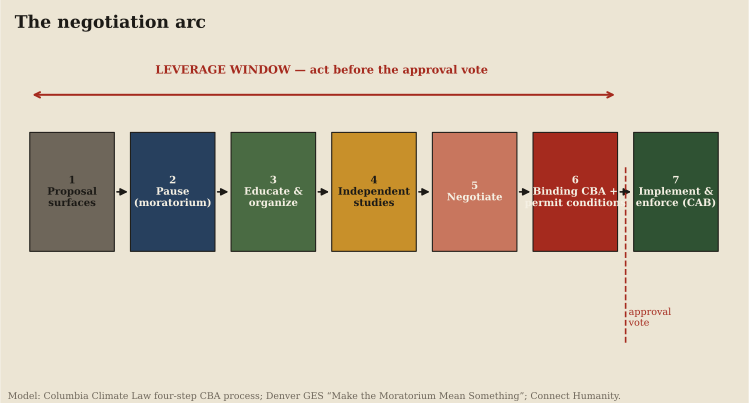
The single most important feature of this arc is where the leverage lives: in stages 1 through 6, before the approval vote. Once the rezoning passes and incentives are signed, the developer has everything it came for and no reason to concede anything further. Every demand in Parts 2–7 — the tariff support, the water caps, the noise limits, the clawbacks, the local-hire targets, the enforcement machinery — has to be won inside that window.
8.2 The leverage clock
Make this curve the mental model for the entire campaign. Community leverage is high while the project still needs the community's "yes," holds roughly steady through the organizing and negotiation phases, then collapses at the approval vote and approaches zero once incentives are signed.
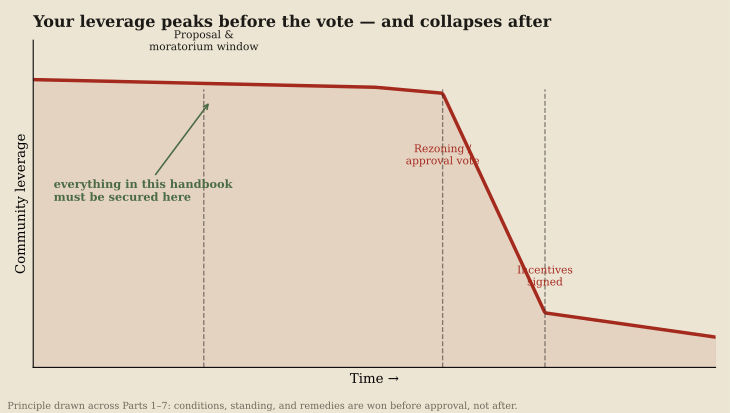
Three implications govern timing:
- The "done deal" problem is a manufactured one. Developers have historically surfaced projects late and quietly — sometimes the mayor learns of a five-data-center plan from the newspaper (Seattle). The antidote is early detection: the interconnection-queue transparency of Part 2 and the disclosure demands throughout exist partly to surface projects while leverage is still high. (Notably, even developers now concede the point — Meta shifted to community outreach 12–18 months before land acquisition specifically to defuse the "done deal" backlash.)
- The moratorium is the leverage-extending tool. A pause stops the clock before the vote, creating the time to organize, study, and write enforceable rules. But — the Denver lesson — a moratorium only matters if it's used to produce binding protections, not vague recommendations. "Pause to protect" (Wisconsin) is the framing: the pause is for writing the ordinance and the agreement, not for waiting.
- Sequencing is everything. Secure the enforcement spine (Part 7) and community counsel funding first, then negotiate substance, then approve — never the reverse.
8.3 Build the coalition: the united front
A community that speaks in scattered individual voices at public comment is easy to wave through. A broad, organized coalition is a genuine negotiating counterparty — and a stronger negotiator the more united it is (We Build Progress). The successful campaigns share a wide tent.
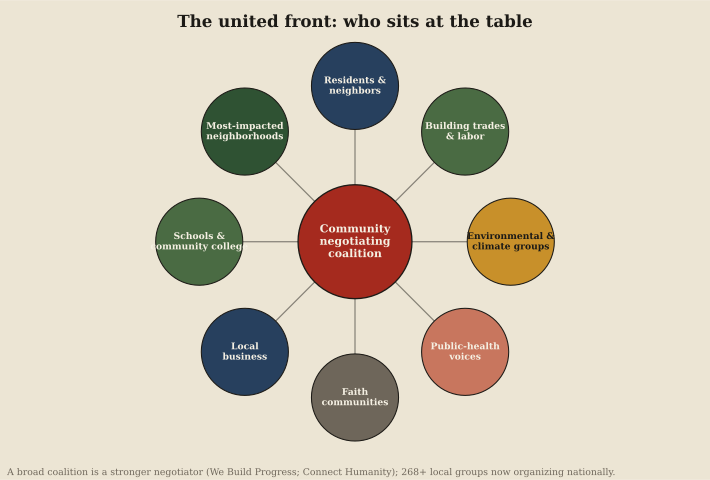
Why each seat matters:
- Residents and neighbors supply legitimacy, turnout, and the lived testimony that moves councils (the jars of brown well water at the EPA hearing, Part 4).
- Building trades and labor are not opponents of the project but allies for good terms — they want the prevailing-wage, local-hire, and apprenticeship commitments of Part 6, and they bring technical credibility on construction.
- Environmental, climate, and public-health groups supply the technical analysis that wins hearings — Howell Township, New Jersey defeated a $1 billion data center after a 200-person panel where FracTracker and other experts presented grid and generator analysis, and the developer withdrew (FracTracker).
- Faith communities and local business broaden the base beyond the usual advocates and signal that opposition isn't fringe.
- Schools and the community college are both impact-bearers (Part 5's service costs) and partners in the workforce pipeline (Part 6).
- The most-impacted neighborhoods — disproportionately lower-income and communities of color (Part 4) — must be centered, not consulted late; the Denver coalition organized in English and Spanish from Globeville and Elyria-Swansea precisely because the burden falls there first.
Two force-multipliers: go regional — opposition groups that shared legal strategies and built regional coalitions drove the 2025 cancellation wave, because a developer that can play one town against the next loses leverage when the towns coordinate (Introl; Connect Humanity). And use the toolkits — communities no longer start from scratch: Wisconsin's "Big Tech Unchecked Toolkit," Food & Water Watch's organizing guides, the NAACP CBA template, and 268+ peer groups mean the playbook is shared infrastructure now.
8.4 Defeat the secrecy
Secrecy is the developer's structural advantage and the recurring villain of this handbook — the NDAs binding officials (Parts 1, 4), the trade-secret water claims (Part 3), the self-reported emissions and jobs (Parts 4, 6), the concealed incentive terms (Part 5). Process-level transparency is how a coalition neutralizes it:
- Demand no NDAs, and make any official's NDA a public issue — "no secret deals" is now a bipartisan rallying cry from Michigan to Wisconsin, where a Republican legislator introduced a bill to ban data center NDAs outright.
- Use public-records law — the Racine FOIA suit (Part 3) shows trade-secret claims over public information lose when challenged.
- Force the project into daylight early — public interconnection queues (Part 2), application notification to affected municipalities (Part 5), and the disclosure demands throughout exist to beat the "done deal."
- Identify the real counterparty — pierce the shell LLC to the hyperscaler behind it (Parts 1, 5, 7), because both negotiation and enforcement depend on knowing who you're dealing with.
Transparency is not a courtesy you request; it is leverage you take.
8.5 Oppose, pause, or negotiate — and the discipline to walk
Part 1 introduced the decision framework; here is where it governs the campaign. The three paths are not mutually exclusive — most successful campaigns pause first, then decide between negotiating and opposing from a position of knowledge.
- Pause whenever the project is moving faster than the community's understanding. The moratorium buys the time to do everything else in this handbook.
- Negotiate if the community would accept some version of the project on strong terms — using the coalition, the funded counsel, and the enforcement spine to drive a binding agreement.
- Oppose outright if the project is wrong on the merits — wrong site, wrong watershed, wrong scale, an already-overburdened community — and organize for denial. The 2025–26 cancellation record proves denial is achievable; it is not a fantasy fallback.
The discipline that ties them together is the walk-away position: decide in advance, as a coalition, the terms below which you will organize for denial rather than sign. A community that cannot say no cannot really negotiate — the developer knows it, and prices its concessions accordingly. The walk-away is what converts the leverage on the curve into actual bargaining power.
8.6 Putting the whole handbook together
The eight parts are not eight separate negotiations — they are one, conducted across several venues at once. This is how they fit:
| Part | The core question | Where it's mainly won |
|---|---|---|
| 1 — Know Before You Negotiate | What is this, and where's our leverage? | Understanding, before any table |
| 2 — Energy & Ratepayer Protection | Who pays for the power? | State PUC + agreement |
| 3 — Water | Whose water, and who's left dry? | Water utility + permit |
| 4 — Environment & Quality of Life | Who breathes and sleeps next to it? | Zoning/air board + permit |
| 5 — Fiscal Terms | Does this net out positive? | Board + state incentive process |
| 6 — Jobs & Economic Justice | Do locals actually get the work? | Board + PLA + workforce board |
| 7 — Enforcement | Is any of it real? | The agreement itself |
| 8 — Process & Organizing | How do we get in the room with power? | The coalition and the clock |
The integration points are where the leverage compounds:
- The independent study (Parts 5, 6, 7) is one study, developer-funded and community-controlled, covering net fiscal, employment, energy, water, and environmental impact — demanded once, used everywhere.
- The shell-LLC problem surfaces in Parts 1, 3, 5, and 7 and is answered once, by the parental guarantee plus successors-bound clause (Part 7, Demand 10).
- Curtailment capability appears as a grid tool (Part 2), a drought tool (Part 3), and an enforcement remedy (Part 7) — the same physical capability, pointed at three goals.
- The community advisory board (Part 7) is where the meters (Parts 3, 4), the reports (Parts 5, 6), and the remedies all converge for the life of the facility.
- Clean-energy sourcing (Part 2, Demand 10) is also the largest water demand (Part 3) and an air-quality demand (Part 4) — one ask, three payoffs.
Negotiate them as a package, in one binding agreement incorporated into the development approval, enforced by one advisory board, backed by one set of bonds and one parental guarantee. That package, won inside the leverage window by an organized coalition, is the whole point of the handbook.
8.7 The demands: what to ask for, and why
Same format: the ask, the justification, the benchmark.
Demand 1 — A moratorium or pause used to write binding rules
The ask: Where a proposal outpaces the community's readiness, a moratorium of sufficient length (commonly 6–12 months) — explicitly directed at producing an enforceable ordinance and agreement, not a study that gathers dust.
Justification: The pause is the leverage-extending tool; it stops the clock before the irreversible approval vote. But a moratorium that yields only "vague recommendations shaped by corporations and lobbyists" wastes the leverage it bought (Denver GES). "Pause to protect" — the pause exists to write the rules.
Benchmark: 14+ states and 100+ localities with pauses; Seattle's one-year moratorium; Denver's "Make the Moratorium Mean Something" platform; Howell Township's six-month pause after a successful campaign.
Demand 2 — Early notification and a real public process
The ask: Mandatory notification to affected residents and municipalities when an application is filed (Part 5), public posting of project details, and a genuine public-comment process before any vote — with no NDAs binding officials past the filing.
Justification: The "done deal" surfacing late is the developer's oldest tactic; even Meta now concedes early engagement is necessary. Early notice is what lets the community organize while leverage is still high. Officials sworn to secrecy cannot represent residents they can't inform.
Benchmark: Connecticut's municipal-notification bill (Part 5); the Wisconsin NDA-ban bill; Meta's shift to 12–18-month pre-acquisition outreach.
Demand 3 — A broad, regional coalition at the table
The ask: Negotiation conducted by an organized coalition — residents, labor, environmental, public-health, faith, business, schools, and the most-impacted neighborhoods — coordinated regionally with neighboring jurisdictions, not by the city attorney alone.
Justification: A united front is a stronger negotiator (We Build Progress); scattered individual comment is easy to dismiss. Regional coordination denies the developer the ability to play towns against each other and was the engine of the 2025 cancellation wave (Introl). Centering impacted neighborhoods is both just and strategically essential.
Benchmark: The 268+ organized local groups; Denver GES Coalition; regional opposition networks; the building-trades alliance model.
Demand 4 — Developer-funded community counsel and technical experts
The ask: The developer funds the community's independent legal and technical experts for the negotiation itself (Part 7, Demand 12), so the agreement is drafted on a level field.
Justification: The power imbalance that produces unenforceable agreements begins at the table — developers bring specialized counsel; communities often bring none. Howell Township's win turned on bringing in technical experts; the difference between a strong and a hollow agreement is whether the community had its own experts when it was written (Clean Energy Transition).
Benchmark: Clean Energy Transition's developer-funded-counsel best practice; the NAACP template's funded legal/technical assistance; FracTracker's role at Howell Township.
Demand 5 — Full transparency; defeat the secrecy
The ask: No NDAs binding officials, public disclosure of all project terms and incentives, use of public-records law to compel disclosure, and identification of the ultimate parent behind any shell LLC.
Justification: Secrecy is the developer's structural advantage across every chapter; transparency is the leverage a coalition takes back. "No secret deals" is now bipartisan; trade-secret claims over public information lose when challenged (Racine, Part 3).
Benchmark: The Wisconsin NDA-ban bill; the Racine FOIA suit; the public-queue and notification demands of Parts 2 and 5.
Demand 6 — An agreed walk-away position
The ask: The coalition defines, in advance and internally, the terms below which it will organize for denial rather than sign — and communicates credibly that denial is on the table.
Justification: A community that cannot say no cannot negotiate; the developer prices concessions to the community's willingness to walk. The 2025–26 cancellation record makes the walk-away credible — denial is demonstrably achievable, which is exactly what gives the negotiating path its power.
Benchmark: The 25 projects canceled in 2025; the $64 billion blocked or delayed; the Pacific, Missouri withdrawal minutes before a hearing (Part 1).
Demand 7 — One integrated, binding agreement
The ask: All commitments from Parts 2–7 consolidated into a single legally binding agreement, incorporated into the development approval, enforced by one community advisory board, backed by one set of financial assurances and a parental guarantee.
Justification: Fragmented promises across venues are easy to lose; an integrated package incorporated into the entitlement carries the full force of the approval and lets the enforcement spine (Part 7) cover everything at once. Negotiating it as a package also lets the community trade across issues rather than conceding on each in isolation.
Benchmark: The CBA-incorporated-into-development-agreement structure (Part 7; PowerSwitch Action); the NAACP template's consolidated, enforceable articles.
Demand 8 — Durable engagement for the life of the facility
The ask: The coalition and advisory board persist after signing, with the funding, standing, and review rights (Part 7) to monitor and enforce across the decades the facility operates.
Justification: A CBA is not finished when signed — ongoing enforcement is what delivers the benefits (Part 7; Clean Energy Transition). The organizing energy that won the agreement must become a durable institution, or the hard-won terms erode unwatched.
Benchmark: The community advisory board (Part 7); the peer-support networks (Wisconsin coalition helping other towns) that sustain engagement over time.
8.8 Where each fight happens
| Venue | What's decided there | Your tools |
|---|---|---|
| The community itself | Coalition, walk-away, regional coordination | Demands 3, 6; the toolkits and peer networks |
| City / county board | Moratorium, notification, public process, the integrated agreement | Demands 1, 2, 7 |
| The negotiating table | Counsel funding, the package, transparency | Demands 4, 5, 7 |
| State legislature | Moratorium authority, NDA bans, notification law | Demands 1, 2, 5 |
| The advisory board (ongoing) | Monitoring, enforcement, durable engagement | Demand 8 |
Sequencing — the whole handbook in one line: detect early, pause, organize broadly, fund your own experts, study independently, negotiate one integrated and enforceable package inside the leverage window, and keep the coalition alive to enforce it — or, if the terms fall below your walk-away, organize for denial.
8.9 The asks at a glance
| # | Demand | Benchmark | Primary venue |
|---|---|---|---|
| 1 | Moratorium used to write binding rules | Seattle; Denver GES; Howell Twp | Board + legislature |
| 2 | Early notification + real public process | CT notification bill; Meta's shift | Board + legislature |
| 3 | Broad, regional coalition at the table | 268+ groups; regional networks | The community |
| 4 | Developer-funded community counsel | Clean Energy Transition; FracTracker | Negotiating table |
| 5 | Full transparency; defeat secrecy | WI NDA ban; Racine FOIA | All venues |
| 6 | An agreed walk-away position | 25 cancellations; $64B blocked | The community |
| 7 | One integrated, binding agreement | PowerSwitch; NAACP template | Board + table |
| 8 | Durable engagement for the facility's life | Advisory board; peer networks | Advisory board |
8.10 A closing note
Five years ago a data center was a ribbon-cutting; today it is one of the most contested land uses in America, and the reason is not that the technology changed but that communities learned to organize. The figures in this handbook — the $14.7 billion capacity spike, the 17 billion gallons of cooling water, the gas turbines beside Boxtown, the $6.4-million-per-job subsidy, the employment cliff — are not arguments for despair. They are the receipts that, in the hands of an organized coalition acting inside the leverage window, have already blocked $64 billion in projects and won enforceable protections where communities insisted on them.
The asymmetry this handbook opened with — the developer's lawyers, consultants, and information against a community's two weeks' notice — is real, but it is not destiny. It is reversed by exactly the things these eight chapters describe: knowing what the facility is, demanding the right terms with the evidence to justify them, building them into one enforceable agreement, and organizing the coalition with the discipline to walk away. The developer needs the community's yes. That need is the leverage. This handbook is how a community spends it well.
8.11 References
Organizing playbooks and toolkits
- Food & Water Watch, "How to Stop a Data Center Near You," March 2026. https://www.foodandwaterwatch.org/2026/03/05/how-to-stop-a-data-center-near-you/
- Next City, "One Wisconsin City Beat Back a Data Center. Now Residents Are Helping Others Do the Same," April 2026 (Big Tech Unchecked Toolkit; Menomonie; "pause to protect"). https://nextcity.org/urbanist-news/one-wisconsin-city-beat-back-a-data-center-coalition-toolkit
- Coalition for Responsible Data Center Development / Evitable / Together Against AI, "Data Center Opposition Report," April 2026 (268 local groups). https://www.datacenterresponsibility.com/
- FracTracker Alliance, "Howell Township Data Center Win," Jan 2026 (200-person panel; expert testimony; developer withdrawal; six-month moratorium). https://www.fractracker.org/2026/01/howell-township-data-center-win
The scale and success of community opposition
- Introl, "Data Center Opposition: The $64B Financial Risk," Feb 2026 (25 cancellations in 2025; regional coalitions; water/energy/noise playbook; 14 states). https://introl.com/blog/data-center-community-opposition-64-billion-backlash
- Introl, "The Data Center Moratorium Movement," Jan 2026 (Sanders/DeSantis; Meta 12–18-month outreach shift; Data Center Coalition lobbying). https://introl.com/blog/sanders-data-center-moratorium-politics-2026
- BLS & Co., "Community Opposition Is Reshaping Data Center Strategy," March 2026 (NY 3-year proposal; IL incentive suspension; 39 gubernatorial races). https://www.blsstrategies.com/insights-press/community-opposition-is-reshaping-data-center-strategy
- Tom's Hardware, "Seattle to pass one-year AI data center moratorium," June 2026 (largest US jurisdiction; mayor learned from news). https://www.tomshardware.com/tech-industry/artificial-intelligence/seattle-to-pass-one-year-ai-data-center-moratorium-next-week-will-use-window-to-study-community-impact-of-ai-buildouts
- Brockovich AI Data Center Reporting, "Communities Making a Difference," 2026 (moratoriums, lawsuits, legislation; Texas 612 reports; Oklahoma HB 2992). https://www.brockovichdatacenter.com/community-impact.html
Coalition and process models
- Yellow Scene Magazine, "Residents and Community Groups... Denver Data Center Moratorium Vote," May 2026 (GES Coalition; "Make the Moratorium Mean Something"; bilingual organizing). https://yellowscene.com/2026/05/17/residents-and-community-groups-to-hold-press-conference-ahead-of-denver-data-center-moratorium-vote/
- Connect Humanity, "How Communities Can Negotiate Public Benefit Agreements with AI Data Centers," March 2026 (regional approach; counterparty clarity). https://connecthumanity.fund/data-centers-are-coming-heres-how-communities-can-negotiate-for-local-benefit/
- We Build Progress, "Community Benefits Agreements," Feb 2026 (inclusive coalitions; united front). https://webuildprogress.org/explainer-2026-02-26-community-benefits-agreements
- Columbia Climate Law Blog, "Community Benefits Agreements and Data Center Development," May 2026 (four-step process). https://blogs.law.columbia.edu/climatechange/2026/05/28/community-benefits-agreements-and-data-center-development/
- Clean Energy Transition Institute, "Community Benefits Agreements: Opportunities, Barriers, and Best Practices" (developer-funded counsel; ongoing enforcement). https://www.cleanenergytransition.org/post/community-benefits-agreements-opportunities-barriers-and-best-practices
Organizing conditions, moratorium status, and live campaigns change weekly. Connect with the peer networks and toolkits above for current, local support before and during a campaign.